Home Blog Page 199

Marga Community Care Supplies to Flood-Af- fected Villages in Sagaing

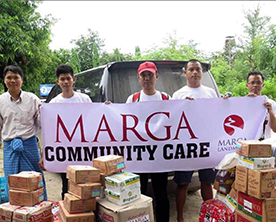
Marga Community Care (MCC) has given away aid and supplies donated by the staff and emergency funds from the foreign real estate group Marga Landmark to flood-affected villages in Sagaing Division. MCC donated to villages of Pay Gone and Chaung Gyar in the Kantbalu Township of Sagaing on July 25. With the help from the rescue committee organized by the local government, the MCC team was able to distribute the relief supplies to the villagers from Pay Gone and Chaung Gyar whose homes and communities were severely damaged by the floods caused by the heavy rains for the last two weeks.

MCC donated 1,500,000 MMK as an emergency relief funds, 2700 units of non- perishable food products, 3000 units of medicine for conditions such as diarrhea, cold & flu, and dehydration, and 840 water purification tablets. In addition, 235 units of clothing were donated by the local staffs of Marga Landmark Company.

John Barnes, Director of Marga Group, said, “The Marga Community Care initiative cultivates the spirit of giving, sharing and community engagement amongst our international and local staff. Especially in the face of natural disaster, we should all get together and act responsively to help those in need. Marga is here to do good to the country which we have always been doing, and we will continue to do more.”

Marga Community Care is a charity program initiated by Marga Landmark, an international real estate developer. MCC had helped out in previous disaster relief programs including the fire in the Balouknyunt and Aye villages in February 2015, and the floods in Bago Township in August 2014.

A Real CSR Experience

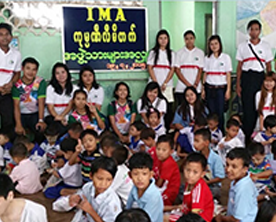
On 19th of July (Matyr’s Day), team Myanmar Insider went to an orphanage for handicapped children and contributed our time, efforts and money wholeheartedly. Aye Myittar centre is in Hlaing Tharyar Township on the western end of Yangon city.

The drive there was long and arduous, yet we have such a unique experience for our hearts and minds. All our team members have a fun time mixing around with the beautiful children, feeding them and performing for them.

All of us need to play a role to help more needy members of the society and what more is more fruitful that helping the children when they need us most. The charity can be reached at 095 00 2311 or 01 688 455. www.ayemyittacenter.org.

OCBC Bank Collaborates with Ten Domestic Banks

OCBC Bank Signed Memoranda of Understanding (MOUs) with 10 Myanmar banks on July 2. The MOUs between OCBC Bank and three state-owned banks and seven private commercial banks mainly emphasize on collaboration in training and capability-building in key areas of cash management, trade finance and treasury solutions to support the anticipated growth in trade and foreign direct investments into Myanmar. The banks aim to jointly develop and introduce new solutions to support their corporate customers in managing the local and foreign currency operating and financing requirements of their investments and projects.

Three State-owned banks are Myanma Economic Bank, Myanma Foreign Trade Bank and Myanma Investment and Commercial Bank. Seven Private Commercial Banks are Asia Green Development Bank Limited, Ayeyarwady Bank, Co-operative Bank (CB), Kanbawza Bank (KBZ), Myanmar Apex Bank, Myanmar Oriental Bank and United Amara Bank.

OCBC Bank signed the MOUs under the witness of Mr Teo Chee Hean, Deputy Prime Minister and Coordinating Minister for National Security and Minister for Home Affairs, Singapore, His Excellency U Win Shein, Union Minister, Ministry of Finance, Myanmar, and His Excellency U Kyaw Kyaw Maung, Governor, Central Bank of Myanmar.

Mr Ooi Sang Kaung, OCBC Bank’s Chair- man said,” We now bring these collaborative efforts to a new level. The MOUs we have signed – on this, the day we officially open our branch, affirm the close working arrangements we already have with the banks. More importantly, the MOUs also commit us to promoting further cooperation in growing the trade finance, cash management and treasury businesses as well as in improving operational efficiency to support these activities. We believe these efforts will significantly contribute to a stronger financial sector that will underpin the growth and development of the Myanmar economy.” OCBC Bank, established in 1932, is combination of three Singapore Bank. Now, it is the second largest financial services group in Southeast Asia. It has over 630 branch- es and representative offices in 18 countries and territories.

Taiwan’s SME Bank, Shares its Experience with Myan- mar Banks

Chairman of E.SUN bank, Mr. Gary K.L. Tseng gave a speech on July 27 at Myanmar Banking & Finance Conference. He discussed about how the government and banks can provide a supporting environment for SME financing and economic growth. Chairman Tseng said that SMEs are essential in a country’s economic development and wealth distribution and E.SUN Bank’s major policy in Taiwan is also supporting SMEs with financial services.

He also added E.SUN Bank’s vision is to provide high-quality financial services in professional, convenient and efficient manner, to help SMEs growth and increase their competitiveness, and thus make E.SUN Bank has long worked with Taiwanese SMEs in support of their local and oversea expansion, primarily in China and Southeast Asia, and has developed a total solution tool kit for their business development an financial arrangements.

Chairman of E.SUN Bank, Mr. Tseng said “Taiwan’s successful experience in establishing and managing parks to help SMEs and export business can be a great model for emerging countries including Myanmar”. E.SUN has an experience with working with Taiwanese SMEs so is the perfect partner to support Myanmar’s SMEs in both financial and consultative role.

E.SUN Bank has also received local and international recognition for its SMEs development efforts. Then, it is the only Taiwanese bank receiving SME Credit Guarantee Partner Awards for 10 consecutive years and ranked No.1 in SME lending volume among private banks in Taiwan. In 2015, it also received” The Best Domestic Bank in Taiwan” from Asiamoney Magazine and “Best SME Bank in Taiwan” from The Asian Banker Magazine.

Founded in 1992, E.SUN Bank is a Taiwan private commercial Bank. It is a wholly-owned subsidiary of the E.SUN Financial Holding Co., Ltd., which was created in 2002 with a total asset of about $49.50 billion. Various cross-border financial services are offering across Taiwan, ASEAN, China and USA with its network of 152 channels. E.SUN Bank has also opened a Yangon representative office in July, 2013.

Government Insider

Myanmar and India Discused Bilateral Relations

During the first Myanmar – India Joint Consultative Commission (JCC), the Ambassador of Myanmar to India U Aung Khin Soe and members of Myanmar delegation including senior official from the Ministry of Home Affairs, Ministry of Rail Transportation, Ministry of Defence, Ministry of foreign Affairs and from the Regional Government of Sagaing and Chin State discuss with India delegation about bilateral issues of mutual interests of further strengthen the bilateral relations and cooperation between two countries. A joint statement on bilateral cooperation, which covers a wide range of issues of mutual interests, was also issued after the successful holding of the meeting.

President U Thein Sein at 7th Annual Cambodia-Loas-Myanmar-Vietnam (CLMV) Summit in Nay Pyi Taw

Myanmar President, U Thein Sein attended CLVM summit which have begun on 22nd July in Nay Pyi Taw at the Myanmar International Convention Centre 1. Minister of Foreign Affairs Wunna Maung Lwin, Thailand’s Deputy Minister and Minister of Foreign Affairs, Cambodia’s Secretary of State and Minister of Foreign Affairs, Vietnam’s Deputy Minister and Minister of Foreign Affair and Secretary General of ASEAN also attended the summit. CLMV cooperation was reaffirmed and discussions were held on upon the following sectors: trade and investment cooperation, trans- port cooperation, agricultural, industry energy and telecommunication/information communication and technology cooperation, tourism cooperation and human resource development. The next annual summit will be held in Vietnam.

Union Labor Minister Discussed Labor Affairs on his Visit to Thailand

Union Minister for Labour and for Social Welfare, Relief and Resettlement U Aung Kyi visit to Thailand and make a discussion for labor affairs especially reality to migrant workers. He also met the Thai Minister of Interior and held a discussion on issuance of temporary passports for all Myanmar migrant workers, persuading employers not to hold passports of workers, free travelling, issuance of stay permits over C of I for dependents of migrant workers, creation of learning opportunity for children of migrant workers at schools in Thailand and opportunity for learning monastic education at monasteries in Mahachaing and Surat Thani regions. In meeting with the Thai Immigration Commissioner, the Union Minister also discussed issuance of stay permit with new form of temporary Myanmar passports through one stop service, reduction of visa fee in making temporary Myanmar passport in line with the coordination and prevention against human smuggling in resending the Myanmar migrant workers to border areas due to various reasons.

Press Conference of Union Election Commission

The Press Conference of Union Election Commission for General election was held on 22nd July in Union Election Commission office Yangon Branch. The president of Union election Commission, U Tin Aye and members U Aung Myint, U Win Kyi and U Win Ko and other invited people attended this conference. In this conference UEC mainly explain the procedures about general election. The president of UEC said that they were trying for people in IDP camp to participate in general election. They also clarify about Budget for general election. They announced that the voters list for the whole countries will be submitted in late August. Myanmar passports through one stop service, reduction of visa fee in making temporary Myanmar passport in line with the coordination and prevention against human smuggling in resending the Myanmar migrant workers to border areas due to various reasons.

Business News

Private Health Insurance to Begin in July

Eleven licensed private insurers will offer health insurance starting from July 1, beginning with a one-year pilot project approved by the Ministry of Finance. A standard rate of 50,000 Kyats will be offered to all healthy citizens between the ages of 6 and 65 years. There are some restrictions on eligibility and applicable services; the treatment of abortion, child delivery, dental, eye or cosmetic surgery, mental illness and drug addiction will not be covered. The Myanmar government has licensed 11 private insurance companies since 2013 and the current types of offered insurance products include fire, motor, life, cash in transit, cash in safe and fidelity bonds.

Ministry Promises tender to Yangon-Dala Bridge

The 48-metre-high (160 feet) bridge, which will link downtown Yangon city with Dala township, will be funded by a US 137.8 million loan from South Korea’s Economic Development Cooperation Fund (EDCF) to mark the friendship between the two countries. “The Ministry and the EDCF have already set rules and regulations for the tender process, which would be launched soon”, according to the Ministry of Construction permanent secretary U Kyaw Lin. This project is estimated to take about five years.

Election to Delay the Opening of Yangon Stock Exchange

The Yangon Stock Exchange (YSX) was originally scheduled to open in late October 2015 but the launch is expected to be pushed back until after the general election. The Exchange is now unlikely to be ready before late November or early December, according to the deputy Finance Ministry Dr. Maung Maung Thein. The bourse is being developed in cooperation with two Japanese Firms, Daiwa Institute of Research and Japan Exchange Group.

Rice Exporters Eye European market

China has so far been Myanmar’s rice exporters’ biggest customer. With Chinese Government imposing quotas and standards on their imports from Myanmar, rice exporters have one looking into other major markets for export. The exporters will attend an exhibition in Milan next month for the first time, hoping to promote Myanmar rice in Italy and other European markets. According to the Myanmar Rice Exporters association, rice exports in 2013-14 stood at about 1.2 million tons, down from nearly 1.5 million tons the year before. At more than 1.7 million tons, the 2014-2015 fiscal year’s rice export volume exceeded the expectations of the Myanmar rice federation which predicted a lower figure at 1.5 million tons.

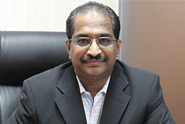
Guiding growth in Myanmar Interview with MKG Myanmar’s CEO R K Varma

[paypal]

MI : When was your first visit to Myanmar?

For a long time, I had been planning to visit Myanmar but due to busy schedule and engagement in other projects in other countries, I was unable to travel to this part of the world. Finally on 1st of April 2015 during a Board meeting, our Chairman Dato Sri Surendra Kumar Mahanty and other directors came to conclusion that I needed to be in Myanmar to head MKG Group operation as with every passing day we were growing in Myanmar.

MI : What was your impression of the country then?

The day I came here, I was really impressed by the business opportunities that we can find in Myanmar. It is heaven for young inspiring entrepreneurs. Other than business, the vast cultural diversity and the landscape beauty that Mayanmar holds is speechless.

MI:How did you end up as your current position?

I joined MKG Group as a director in Dubai and have been taking care of operation in different countries, as MKG started operation in Myanmar in September 2014, and the success we had during this short period and as we started getting more opportunities, our company needed someone who could guide our organization towards the growth and this way I came here as CEO to head MKG operating in Myanmar.

MI : Since when MKG has been operating in Myanmar?

MKG had been studying business prospects in Myanmar for last 2 years and were looking for the right opportunity and the day came that is in September 2014 in real terms when we were on ground with our operation team.

MI : What are MKG’s services for Myanmar?

MKG is capable to provide End to End solution for Oil & Gas and Telecom Industry which involves Engineering, Procurement, Construction and Commissioning along with other services such as Operation and maintenance.

MI : What are the current projects that your team has been working?

Currently MKG is executing telecom towers construction for one of the leading telecom providers in Myanmar and providing our services to keep the towers in running condition through maintenance of the existing facility, So that people using telecom services are never out of coverage.

MI : Please tell us more about your future plans and projects.

MKG at core is a construction company and has been dealing in OIL and GAS construction (Civil, Piping erection of equipment, Commissioning testing maintenance and many more activities related to OIL and GAS with major client in various part of the world. So we are looking to tap this growing opportunity in Myanmar and for that discussion is ongoing with many Oil & Gas companies in this field who have established there foothold in Myanmar.

We are doing feasibility study to establish an one stop solution for Fabrication workshop along with Skilled training center to cater the needs of the OIL and Gas Industry.

Trading in various commodity also is in the road map for our Myanmar operation.

MI : How do you deal with customers’ expectations here?

MKG have one mantra and its applicable through out the world were we work and part of our corporate policy “ We will provide high quality serviced through best practices while conducting our business in a responsible, safe and profitable manner with a target of zero harm to people and the environment” and “Total customer satisfaction through high quality high performance and cost effectiveness”.

MI : From a business standpoint, what do you feel are the biggest challenges facing you and your team in Myanmar in next 1-3 years?

Skilled manpower is the main constraint that we face. Construction industry needs highly skilled manpower with quality and safety awareness. Also other problem is the language when we are working in the remote location and MKG has decided to overcome both as we will be having Myanmar Language speaking course for expats and Skilled Training Center as our one of the future commitment to Myanmar.

MI : What effect do you think that the sudden influx of foreign companies/ nationals will have?

There will be competition between the company of the same industry which will directly benefit the customer and the consumer, also the local community will be getting more employment opportunity which will elevate living standards of the local resident. Transfer of skill will also happen from foreign nationals.

MI : What advice would you give to someone looking to start up a business and invest in Myanmar?

To a group who would like to start business and invest, my suggestion is to look around as lot of opportunity is waiting around to be grabbed in the respective field of expertise. There is huge scope for improvement in every field which will certainly payback in future and it’s the right time to enter.

MI : If you could make one major change to any government policy, what would it be?

In Myanmar, the major change that needs to be considered is the banking policy along with the ease of export and import and single window approval which can help Myanmar grow in a rapid pace.

MI : How are you enjoying your days in Myanmar?

I am enjoying the challenge and the opportunity in Myanmar and really loving the beauty of Myanmar that it holds along with the pleasant climate.[/paypal]

Colourful Southern Shan State

L ocated in the eastern part of Myanmar, southern Shan State is one of the best places to visit and relax in summer. In colonial period, senior government offcials head to in Kalaw or Taunggyi to spend their summer. Shan state is also very diverse and colorful region since it is home to many national races including Shan, Palaungs, Danu, Lahus, Inthas, Taungyoe, etc. Almost all ethnic groups have their own traditions and cultures. Then, the places in Southern Shan state especially Kalaw, Pindaya, Inle lake, Kakku , Taunggyi, Htam Sam Cave are defnitely worthy a visit. You can easily get there and also do not need to worry for accommodation. In almost every region of Southern Shan State, there is a fve-day market, where you can buy various fresh and cheap products from local inhabitants’ own farms.

Kalay

Kalaw has been very popular hilly resort since the colonial period. It is located 1320m above sea level and surrounded by pine trees and Shan plateau. The distance between Kalaw and Yangon is only 634.2km. One can reach Kalaw within 7 hours by car. You can also get there by train. There is direct train from Yangon that takes 26 hours to reach Kalaw. Such a long duration is due to having many stop overs along the way. However, the landscape is astonishing, nice and mountainous and dramatic. Around Kalaw, there are also many interesting places to visit and do many activities including hiking and trekking. Green Hill Valley Elephant Camp, a 45-minute drive from Kalaw is recently popular in Southern Shan State. Visitors to this Elephant Camp can find local village traditions and natural beauty of the surrounding forest and get opportunity to learn about Mahouts and their Elephants in the nature. Then, the visitors can also participate in this Elephant Camp’s program; replantingand conserving of the forest to save the environment.If you are interested in trekking, Kalaw has a lot of trekking companies, with a variety of treks.

Pindaya

Although Pindaya is a small town in Southern Shan State, it becomes one of the mustsee tourist destinations of Myanmar for its famous limestone caves. Pindaya is Danu Autonomous Region and the main inhabitants are Danu and PaO. If you want to go Pindaya from Kalaw by car, it takes only 45-minute. Pindaya caves containing thousands of ancient Buddha stuppas is the major tourist attraction of Pindaya. You should not miss to visit Boataloke Lake where seven fairies used to take bath according to legend. There is no luxury fve-star hotel in Pindaya but you do not need to be anxious about accommodation. Accommodation options include a number of good hotels and guest houses. Those on budget almost all monasteries are always ready to welcome the visitors including foreigners (male and female) for the night.

Inle Lake

Located in heart of Shan plateau, Inle Lake is second largest fresh water lake in Myanmar. You can reach there with 30 minute drives from Taunggyi and 1hr half hour drivefrom Kalaw. It is mainly famous for unique life style of local people especially leg – rowers. Floating villages and foating market are the main attractions. If you are at Inle Lake, you can hire a boat and visit around the lake in one day. For people who want to stay at Inle Lake for two or three days, there are lots of hotels and guest houses for accommodation. The Paungdawoo pagoda is worth for a visit and pagoda festival is held in every October. You can also taste real Intha Montti which is unlike Myanmar famous Mohingha and buy traditional cotton and costumes, silver wares and other handicrafts there.

Taunggyi

Taunggyi, the capital of Southern Shan State is chosen as one of the best place to live in Myanmar. Peaceful environment and cool weather make perfect for people to live in Taunggyi. It is located 1436m above sea level and it takes around 8hr to reach Taunggyi from Yangon. There are also daily direct fight from Yangon. Many famous pagodas are located around Taunggyi and each has its own history that was really interesting. If you are in Taunggyi, you should not miss out. The Cultural Museum where cultural objects, musical instruments, traditional dresses, farm implements, paintings, sculptures, handicrafts of the diversity of ethnic groups residing in Shan State can be seen. The Myoma Market is the most colorful and busiest part of Taunggyi since it is the gathering point of different ethnic group residing in Taunggyi. Aye Thar Yar Vine Yard is also popular among tourists. Drinking winein Vine Yard and looking at mountain scenery is the best thing for the visitors. The most famous event in Taunggyi festival is Air – balloon festival, which is celebrated in every November. Various Shapes of hot air balloons are released into the sky. This festival is the biggest and most famous festival not only in Shan State but also in the whole country.

Htam Sam Caves

Compared to Pindaya Caves, Htam Sam Caves are not that popular among tourists. However, it becomes more and more popular among local travelers. You can reach there about 30 minutes drive from Taunggyi. Township where Htam Sam Caves are situated is under PaO Autonomous Region. It is long and large lime stone cave. Htam Sam Caves were frst discovered by a monk, named Ko Yin Lay. You can have free lunch the monk offers every day in Htam Sam Caves. You should not miss this lunch since it is really well cooked and delicious. On the way to Htam Sam Caves, you can take a rest in Ho Pon and eat Tohu salad which is also really tasty.

Lurel of a leaf

(Tea) to the guests with whatever other food or delicacies may have been proffered. Kun or betel takes pride of place among these three “musts” and to this day a betel box, particularly made of lacquer ware, is placed before guests in many homes. Burmese believed (some of them still do) that offering betel is to show warmth to the guests and to become friendlier with them while chewing and talking. It was a kind of an entertainment at that time. Men, women and monks of all ages and ranks chewed

betel. It was embedded in social convention and court ceremony, and a betel quid was a token of favour in village courtship and royal courts. Burmese history also mentions an ancient custom of a condemned enemy asking for “a Kun-ya and a drink of water” before being executed.

In Asian countries like India, Vietnam and Sri Lanka, a sheaf of betel leaves is traditionally offered as a mark of respect and auspicious beginnings. Occasions include, greeting elders at wedding ceremonies, New Year, offering payment to Ayurvedic physicians and astrologers where usually money and or areca nut are kept on top of the sheaf of leaves and offered to the elders for their blessings. In Vietnam, a groom might offer the bride’s parents betel and areca, the leaf and the nut symbolizing the ideal married couple bound together.

A betel quid is the name given to small parcels that typically contain areca nuts, wrapped in a betel leaf coated with slaked lime and may also contain tobacco. Spices may be added for taste including cardamom, saffron cloves and sweeteners. Betel chewers are still very prevalent in Myanmar, and one can see sellers at any busy intersection, offering betel quid to car drivers as they wait for the traffic light to go green. And at any street corner, you can find a little stall with

a tray piled high in a most attractive man- ner with green betel leaves, and a little pot of lime and small canisters and bottles full of ingredients to suit every taste.

The chewing of areca nuts dates back centuries, as far as the Bronze Age, according to a study of remains excavated at Nui Nap, Thanh Hoa province in Vietnam. Researchers found the teeth appeared to be stained by betel quid. World Health Organization reports that betel leaf is consumed, in Southeast Asian community worldwide, predominantly and also among migrated communities in Africa, Europe and North America. In an extensive scientific research, the WHO expert group for research on cancer reported that the percentage of oral cancer among all cancers diagnosed in hospitals in Asia has always been much higher than that usually found in western countries, where the habit of chewing betel quid, with or without tobacco, is virtually unknown. Researchers also noted that the cancer generally develops at the place in the mouth where the betel quid is kept. “Having one (betel quid) is okay, but the danger increases when you start having the second one. When you reach a certain point, people will get cancer,” said Professor Ying-chin Ko, vice president of China Medical University in Taiwan who conducted some of the first studies into the link between betel quid and oral cancer. Some evidence suggests betel leaves have immune boosting properties as well as anti-cancer properties.

There are about 100 varieties of betel vine in the world, The Burmese betel leaves, with bigger leaves with dark green color combined with thickness, are in great demand in several other countries of the world where demand far exceeds the local supply. Consequently, leaves worth about more than a million USD are exported to European countries. Thus it is most promising commercial leafy crop capable of attracting substantial amount of foreign exchange to the country.

The deep green heart shaped leaves of betel vine are cultivated intensively for its leaves which are consumed by more than half a million people in the country. Ancient traveller Ibn Battuta describes the betel growing as follows: “The betel is a tree which is cultivated in the same manner as the grape-vine; … The betel has no fruit and is grown only for the sake of its leaves … The manner of its use is that before eating it one takes areca nut; this is like a nutmeg but is broken up until it is reduced to small pellets, and one places these in his mouth and chews them. Then he takes the leaves of betel, puts a little chalk on them, and masticates them along with the betel.” Cultivation of betel creeper is tough and it needs fertile soil. Since it is a creeper, it needs a compatible tree or a long

pole for support. The farm yard is fenced with bamboo sticks and coconut leaves. The creeper cuttings are planted after proper dressing at the beginning of the monsoon season. The plants are neatly arranged in parallel rows about two feet apart, and the saplings are twined around upright sticks of split bamboo and reeds. Proper shade and irrigation are essential for the successful cultivation of this crop. The plants are regularly watered in the hot months. The leaves of the plant become ready for plucking after one year of planting and the production lasts for several years from the date of planting. Betel needs constantly moist soil, but there should not be excessive moisture.

Betel leaf is a popular spice in Southeast Asian cooking, with the leaves being used in their raw and cooked form. A traditional way of preparing the leaves is as a wrapping for spiced minced meat and other morsels of food. Because the leaves are so attractive, they are often used as a base for decorating platters, with food arranged on top of them. The white flower spikes of the betel plant develop into seeds or fruits that look a little like a green/brown mulberry when ripe and can be eaten; it is a tasty morsel of sweet- meat.


The China Loan : Managing And Sustaining Devel

Addressing financial needs in the rural areas

tloan extended by the China Exim Bank. A report entitled Rural Development, Socioeconomic Improvement, Poverty Alleviation and the Cooperatives distributed during the celebration of International Cooperatives Day held in Nay Pyi Taw last July 4, stated that 203,539 million Kyats were provided to cooperatives in 307 townships in 15 states/divisions nationwide. The port- folio included the $100 million from the China Exim Bank received in December 2013 and April 2014. Dubbed as Micro Cap- ital Loan, the funds were distributed to individual borrowers at 100,000 Kyats each, for agricultural production or rural enterprises.

The report further stated that the lending program registered 100% repayment rate to date.

Prior to its approval, some members of the Pyidaungsu Hluttaw expressed reservations in recommending for the government bor- rowing from China because of concerns on the management of funds and the capacity of the government to repay the loan. With a

ten-year term, the loan is charged with 4.5% p.a. and retailed to individual borrowers at 1.5% per month.

The initial report looked promising and per- suaded the Pyidaungsu Hluttaw to approve the second tranche of $300 million. It has improved features, increasing the maxi- mum individual amount at 500,000 Kyats and lowering the interest rate at 1.1%. In addition, $30 million of the tranche was set aside for agricultural mechanization pro- gram, with loans devoted to hire-purchase of agricultural machineries.

The hire-purchase scheme for agricultural machinery is another project of the MOC in partnership with the Daedong Industrial Co. of South Korea. The company distributes agricultural machineries such as power tiller, tractor, pumps, transport tractor, lawn mower and trailer. It partnered with the MOC and offered two schemes: direct cash purchase or hire-purchase arrangement. The term of the arrangement is 7 years, with the recipient giving 10% of the purchase price and twice-a-year amortization. Latest data showed 154,289 units of agricultural machineries were distributed through this arrangement.

Contribution to financial inclusion

The China loan contributed to increase access to credit in the countryside. The pro- gram enabled people in the rural areas to access financial resources they can use to venture into productive economic activities. It is expected that local economies will be energized as a result of the infusion of fresh financial resources to the communities. Farmers were among the main beneficiaries as most loans were expected to finance agricultural production. It will support purchase of inputs and in some cases, acquisition of farm machineries. The funds may either augment whatever resources from government banks that have been provided as part of other programs.

Gaps, issues and concerns

Despite the supposed benefits, there remain questions on the long term sustainability of the lending program. Foremost among the concerns is the management of funds. There is no question on the capacity of the MOC as a government agency, but the issue is that loan management is not part of the ministry’s core competencies, but that of a financial institution. MOC can best manage the development and institutional strengthening of cooperatives rather than manage loans. Present results may show 100% repayment rate but that may not be the case during repeat loans and in the succeeding loan cycles. Lessons in agricultural finance reflect deterioration in loan portfolio over a long period as the farmers encounter production problems like natural calamities and fluctuations in prices of agricultural products, limiting their ability to pay back loans.

Relative to this issue is the capacity of the conduit institution. It is not workable for the MOC to do direct lending to individual borrowers. It has to wholesale the funds to cooperatives who are more familiar with their members and thus identify who may borrow and who may not. Cooperatives as conduits have to be organizationally strong with the capacity to handle the complexities of managing lending operations. Most of the village-level cooperatives at present may not be strong enough to handle lending operations involving huge amounts.

The present all loan product. Appropriate product design is an important element in any lending program and should meet specific needs of various kinds of rural borrowers which can be segmented into three: subsistence-level livelihood activities (like ambulant vendors), micro-enterprises that has attained certain level of stability and business volume (like grocery stores) and agricultural production. Most microfinance practitioners have developed microagri loan product considering the distinctiveness of agricultural production.

There was also the concern for the overlap- ping of the program with the present lend- ing program of the Myanmar Agricultural Development Bank (MADB). The possibility of borrowers receiving loans from both the MADB and the MOC is not farfetched. The fear is that instead of reducing poverty, the program might end up with people deep- er in debt.

Risk management is quite limited at this point. No facility for crop insurance that will absorb the shock when calamity occurs. This may limit the number of people who can borrow again after each calamity, and those who cannot borrow from the program may end up back to informal money lenders, and more deeper in debt.

These are some of the issues that have to be addressed immediately to ensure that the program will indeed support sustainable development in the rural areas, and will not end up burdening the people with more debt.

collection and remedial management for past due accounts.

  1. Development of financial intermediary cooperatives.

Cooperatives as conduits of loan funds should be strengthened and upgraded. A capacity building pro- gram should be implemented to en- hance the capacities of cooperatives. In addition, there is a need to merge small village-level cooperatives into village-tract level or the township level to have economies of scale. Big- ger cooperatives with more members and with more financial resources and with full-time staff should also assume financial intermediation functions – mobilizing savings from its members and the community and providing loans to support economic activities of the members. Financial education advocacy will also be an important role of the cooperatives.

  1. Integrated agricultural production

Support to agricultural production should be aimed towards integration. At present, MOC initiative supports production stage through the Micro Capital Loan and the farm mechanization. Through the cooperatives, it should be programmed to control the whole value chain of agricultural commodities. This means the co- operatives would also have its own post-harvest facilities and processing facilities, marketing arm and trans- port facilities. Integrating production through the cooperatives will make possible the farmers’ capacity to control the price of agricultural commodities.

Debts when managed well can be used to facilitate sustainable development, or if not, it can be a burden to taxpayers.

Micro Capital Loan is a catch-Policy recommendations

Based on the status of the program, three broad strokes can be recommended to make certain that the program will be ready to face challenges soon.

 

Latest Videos

Interview with Alison Fox Principal of The British School Yangon

Interview with Alison Fox Principal of The British School Yangon

Recent Posts