Home Blog Page 25

One of the Two Certainties in Life Not so Certain After All
“There are only two certainties in life: death and taxes” the famous quote says. Yet in Myanmar, tax system is nothing but certain. A good tax system should follow four basic principles: fairness, certainty, convenience and efficiency. The country is either backward or inadequate on each of the four principles.

Main issues

The first issue relates to none of the four principles. It is a cultural issue where people are simply not used to paying taxes. Even though we were taught calculus, trigonometry and advance mathematics in high school, the subjects 99% of us have no use in life, we were not taught about finance, accounting or taxes. Taxes are not taught in universities either, other than perhaps in accounting, finance and economics courses. So students have been taught to stand up in the cinema during national song and rising of national flag, yet, they were definitely not taught that paying taxes is a mandatory civic duty for all citizens. When adults have to pay taxes now, they tend to question on what the government would do specifically for them, for paying taxes. They look for direct benefits akin to a business transaction. No one has been taught that it is patriotic and stately to pay taxes, hence, no one is motivated to pay.

This issue not not limited to Myanmar alone. Even in the world biggest county, our good neighbour China, only 2% of the population pay taxes. Considering being the world second largest economy, it suggest there might be significant grey economy within China too, likely conducted via WeChat. That modus operandi even extends to the famous jade market in Mandalay, where the money changed hands via WeChat pay, evading any form of taxes payable to Myanmar or Chinese government.

This habit of not paying taxes is evidenced in the amount of tax revenues as a percentage of GDP (Gross National Product). In US, that percentage is 17%. For China, it is 9%. Myanmar government tax revenues as a percentage of GDP varies between 5% – 8% in the past ten years. If the grey economy within the country is to be included, the percentage would be a lot lower. It means, essentially, MOPF (Ministry of Planning and Finance) has two main tasks; to induce the population to pay taxes and to include more grey economy into tax assessments.

The second issue is the implications for non-payment of taxes. May be the government does not have the resources or competence to track down tax dodgers. Or may be government is holding that offence as a hidden card, in case of wanting to charge or arrest a person on a separate charge, which has insufficient evidence to apprehend that same individual. Without much serious implications, people here got used to the concept of paying only upon need basis, such as when they need white money or when they buy something that needs registration or disclosure, etc.

One of the common complaints from regular payer of taxes, through pay as you earn system for middle and high income earners, has been the fact that the monthly taxes that they had paid are not fully allowed for offset against the white money requirements. The sometimes promotional tax rates between 3%-10% are also a disincentive for regular payer of taxes, such as wage earners. The effective tax rates may be a lot higher than 3%, especially for high wage earners. So why pay regularly?

Even if the tax dodgers or under payers or late payers are found, the penalty is normally just 10% of the outstanding tax liability. Even if the tax liability has been outstanding for only a year, that 10% is less than the current borrowing rate of 13%. Technically, it is better off financially to delay paying taxes, rather than go into debt or overdraft in order to pay taxes.

The third issue is related to companies. Currently there are two tax assessment systems in place for companies and businesses: Official Assessment System (OAS) and Self Assessment System (SAS). SAS has been applauded by most tax payers for convenience and fairness, especially for the ability to do online and claim allowable expenses first. The eventual target would be for all companies to be able to filed under SAS. At this point of time, only large tax payers and some medium tax payers are being able to filed under SAS. There comes the legacy issues related to OAS. Paper based system means loss of documents sometimes. Frequent change of tax officers in charge is not helping either. The assessment is simply subject to tax officer whims and fancies, that could eventually gives rise to under table payments and corruption. If you happened to dispute the tax officer assessments, he or she would put your case under ‘pending’ leading to years incommunicado from either the officer or income tax department.

The fourth and final issue seems to be systemic. The tax system in Myanmar is a direct descendant of the British system, in which the tax law is principle based, instead of rule based, just like the US. Principle based systems are subject to many interpretations and a lot of interpretations are based upon precedents. With the judicial system in Myanmar very much underdeveloped, especially in relation to commercial cases, precedents are hard to come by as companies rarely challenged the tax department decisions. The usual approach would be to resolve through ‘negotiations’ with the tax officer concerned.

Typical Complaints

Typical complaints by business taxpayers would include the allowing of expenses in the income statement, not being able to carry forward losses (especially in relation to OAS), preference being given to irregular tax payers over regular payers and commercial tax payments being not in line with collections.

The way forward

How do we best achieve fairness, certainty, convenience and efficiency in our tax system? MOPF is already on the right track pushing for conversion from OAS to SAS. May be due to Covid or change of government, the process has been slow and hence, the results have not materialised yet. SAS would reduce human to human interactions (‘negotiations’). Doing everything online would reduce paperwork and loss of paperworks. Best of all, the responsibility to be honest is pushed towards the tax payer and the responsibility to dispute against the tax filed is in the hands of the tax officers. Supplement that with education across all ages, especially the young ones, coupled with continuous training for tax officers, we would have a fair, convenient and efficient system in no time.

A Forever Fledgling Exchange?

YSX is trying to get out of the ‘fledgling exchange’ moniker sooner rather than later. Yet based on our analysis its latest yearly report, it would still take a long while to achieve that.

As of March 31, 2022, there were nearly 45,000 trading accounts being held by investors and traders. In a country with a population of 55 million in an exchange allowing foreign ownership of listed local companies up to 15% of the capital, this represents less than 0.1% of the entire population. Just for comparison, there are 33,000 trading accounts in Cambodia, with 17 million population, representing 0.2% of the population. And, 2.5 million accounts vs. 70 million population in neighbouring Thailand, representing 3.6% of the population.

Trading statistics does not board very well either. With the number of listed companies of just seven, the market capitalisation was at a miserly $304 million. Cambodia got nine listed entities with a market cap of approximately $4 billion. The Thais got a well developed market with a capitalisation of $500 billion, represented by 800 listed companies. Daily trading volumes were at $30,000, $0.25 million and $2 billion in the three countries, respectively.

Neighbourhood WatchTrading Accounts (‘000)Market Cap ($mil)Daily Volume ($000)
Myanmar4530430
Cambodia334,000250
Thailand2,500500,0002,000,000

SECM (Securities and Exchange Commission of Myanmar) is facing an uphill tasks to even catch up with the second poorest country within ASEAN. Myanmar has taken the honour of being the poorest since 2017 (World Bank data, based on GDP per capita). MI recently spoke to the Secretary of SECM recently to understand better on the activities in the coming years, in order to stimulate the fledgling market. From educating the population to changing of the investors mindset, introduction of the second board (similar to Thailand’s MAI) to encouraging six licensed security companies to trade on their own accounts, allowing the trading of T Bonds/T Bills to ensuring compliance, SECM  is pushing hard, within its limited resources and a lacklustre economy, to play the inevitable catchup game.

Stock exchanges are extremely important in a capitalist economy, for economic development of the nation. From the economics perspective, capital matching and allocation, investments and FDI, all become much easier with an exchange. From the businesses perspectives, raising money to expand,  grown and internationalise, are best done via an exchange. An exchange gives a listed company a power akin to printing money, through selling of its shares (papers) to investors and public.

Myanmar population in general as well as local businesses are not familiar with the mechanisms of the YSX (Yangon Stock Exchange). With all its announcements and reports being kept solely on its website, instead of national or private media, the push branding approach is missing at present. Even the senior personnel from government clearly owned media channels do not know what YSX is.

In terms of mindset, most investors are not used the capital appreciation concept yet in Myanmar. They look forward to dividends from their investments every year. ‘Bird in the Hand’ theory of dividend policy would be of significant use in the country. YSX seriously needs awareness and branding campaigns in order to be well known, attract investors and change the mindsets of existing traders.

Introduction of the second board and asking security companies to trade on their own investment accounts seem to be both very good approaches. At the same time, a change in trading rule from prepayment system to a credit system, to implement the genuine T+3 settlement concept would be more welcoming and fruitful. At present, in order to buy shares, potential investors have to deposit money into their own accounts with the security companies first (earning no holding interest) or have money in the bank account linked with the security company. This is not in line with the trading environment overseas. Considering the top two markets within ASEAN, Singapore and Thailand, the investors are given a credit limit on their trading accounts. These investors can call up their their brokers or get online, without having to deposit a cent, to buy shares. When it comes to settlement day, if the investor does not have funds to settle, the security company can simply sell the shares in the market, requiring the investor to pay up the trading loss only, if any. The credit limit system also allow investors to do the CONTRA – buying and selling prior to settlement – easily, without getting the full payment involved, which in turn increases market activity.

According to SECM, they also did the identification and selection of potential companies to be listed on the exchange. It is also appropriate since most of the local businesses might not approach the exchange or security companies on their own initiatives. SECM reach also expands to public companies with at least 100 shareholders, now nearing 50. All in all, among these public (not yet listed) companies, approximately 75% of them has an ‘Insufficient’ compliance rating by the SECM. The companies themselves have a long way to go.

The sole purpose of SECM is stated on its website, “structuring, developing and promoting Myanmar Capital Market”. SECM has its work cut out. Even catching up with Cambodia would be an extremely tough row to hoe!

Uproar in Mobile Financial Services

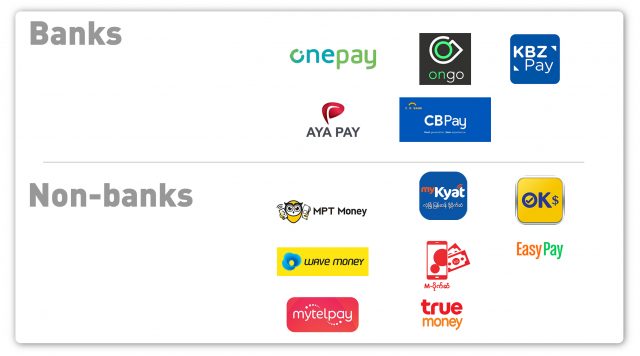
There are about 24 million mobile wallet accounts in Myanmar. These accounts come from non-bank wallet providers, as well as, banks. The popular non-banks Mobile Financial Services (MFs) providers are Wave Money, OK$, M-Pitesan, My Money and MPT Money. A third of 35 or so licensed banks also have wallets or are in the process of applying for wallets licenses. These wallet accounts are typically divided into two tiers: Level 1 and Level 2. Level 1 is given without ID verification and Level 2 is for those with their ID already verified.

As recent as last month, there has been an uproar, at least in the Facebook, over CBM’s (Central Bank of Myanmar) plan to require conversion of all Level 1 wallet accounts to Level 2, within a period of three months. Given that Level 1 accounts about to 18 million, it seems to be an enormous tasks for everyone, to complete before the year end.

A lot of people ended up interpreting the signals from CBM negatively; some thought it has something to do with terrorism funding to NNCP terrorist groups, some speculated the government just needed the money from dormant accounts, some created the rumours that CBM is creating revenues for government through confiscation of Level 1 accounts. Nothing can be further from the truth.

FATF Blacklist

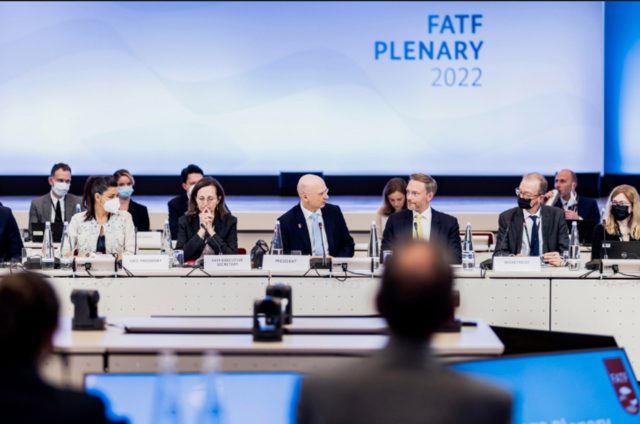
CBM has been trying hard to address the AML (Anti Money Laundering)/ CFT (Combating Financing of Terrorism) issues and accusations internally to address the findings and recommendations of FATF (Financial Action Task Force) for quite sometime. During the third week of October, MI has learnt that Myanmar has been moved to the blacklist by the FATF from the previous brown list. There was some panic in the social media, some speculators exploiting on the news to push up the $ exchange rate to 6,000 Kyats, if truth be told, albeit no buyers. Once most people realise the lack of impact of this blacklisting on domestic economy, the $ fall back to the original pre-news price around 2,500 Kyats.

Most people have now realised that Myanmar was under black list for all years under President Thein Sein administration, yet the country’s best days of economic growth and prosperity happened under his watch. The country was moved up to brown list around 2016 and now it is back to the original blacklist. The likely impact of this would be on Myanmar nationals and companies having overseas bank accounts and NNCP terrorists groups and their donation collectors, as the banks overseas would now have to conduct more thorough due diligence and KYC (Know Your Customer) checks, prior to accounts opening or transfer transactions.

Moving Up to Level 2

Forced changeover of all wallet accounts into Level 2 is also in line with eKYC and eID requirements for all digital money accounts. During the implementation period of mobile wallets nearly ten years ago, the government and the advising international organisations’ primary objective was financial inclusion. Both wanted the wallets and easier transfers to be available up to the most underprivileged. In order to encourage widespread use of mobile wallets, the account opening requirements and KYC requirements are not set as first priorities. As long as you have a phone number, here comes the digital wallet for you.

As time passes, both CBM and the government realised this created a lot of potential fraud opportunities. Rural population of Myanmar are also easily gullible, so the number of fraud cases kept on increasing every year. Hence, the requirement for KYC now.

The process to more up to Level 2 is relatively simple: the customer has to submit a copy of their ID card, front and back, digitally or at the offices of the mobile payment companies/wallet providers. CBM expects the process to be completed within five months. Based on the stratification, the top wallet KBZ Pay already has 10 million accounts, out of the whole country Level 1 total of 18 million, followed by Wave Money and OK$. CBM is confident that 95% of Level 1 accounts would be successfully upgraded to Level 2 during this period.

One of the concerns expressed by the general public was what would happen to the accounts not converted to Level 2. CBM estimate of 95% conversion translates into nearly one million dormant accounts, that would not be converted. Obviously, one could reason it out that, if the account holder does not care about his own money, who else would!

These leftovers are not for MFS licensed holders either. All non-bank wallet providers have to keep security deposits in a trust account with a partner bank, an equivalent amount of the sum of total wallet accounts balances. The interest earned on these accounts also have to be used for industry development purposes only (such as conversion fo Level 1 to Level 2). From the customer perspective, however, these accounts are non interest bearing. Even if $10 is left in each account, the value of the dormant accounts would be nearly $10 million and the sum of all wallets balances would have reached $240 million.

The Future of Digital Wallets

This ID upload requirement is just the first of many verification steps for KYC. For bank owned MFS (Mobile Financial Services) or mobile wallet operators, it is relatively simple, as they are linked to their respective bank accounts. The final consolidation would be all wallet owners be matched with their owned registered SIM cards and their ICs, in coordination with the database from Ministry of Transport and Telecommunications (in charge of telephone SIM card registrations) and Ministry of Immigration (in charge of IC database). Only there would there be total integration of services through linkage to the correct beneficial owner of a particular wallet account, that corresponds with his ID and mobile number.

As far back as 2018, CBM has boasted that mobile wallet integration, i.e., the ability to transfer from one wallet provider account to another, just like banks, would take place within 12 months. Yet, four years down the road, the integration is still a WIP. CBM has further promised that it would be completed before the end of 2023, during a recent meeting.

Regardless of how onerous it might be, this KYC improvement is just another bitter pill to swallow, not only for CBM and the government, but also for compliance with BIS (Bank of International Settlement) requirement and ASEAN wallet inter-operatability obligations, which requires full KYC on all wallet accounts prior to allowing transactions across borders.

The wallets are here to stay in the country. People have gotten used so much to the ease of operability of the wallets that, we cannot fathom how this simple KYC step would put a wall to the continued popularity of the wallets. In 2021, there were around 700 million wallet transactions amounting to ~$21 billion, at current exchange rates. This total is nearly one third of Myanmar GDP, highlighting the prevalence of transfer payments among citizens and probably continued domination of grey economy in our daily lives. Based on these two statistics, the average wallet transaction size amounted to $30 in 2021. The wallets cannot be subdued. Within the first nine months of 2022, the transaction number has reached 680 million with a value total of ~$18 billion. Both figures would surely surpass those of 2021 at the end of current calendar year.

Family Gardener

Mother in a family is a great pillar for the children, playing the pivotal role of nurturing them, surrounding them with immeasurable love, warmth, kindness, and bringing them up, guiding them to know the right from the wrong, ultimately molding them into good, responsible and reliable citizens for our country. As the saying goes: “Mothers make hearts bloom”, it is indeed the mother who makes the kid’s heart grow full of positive attributes like love, passion, empathy, leaving no room for negative feelings that normally lead to hatred, jealousy, vengeance and the like. In Fact, the hand that rocks the cradle poses as the true gardener for the children in the family.

In general, mothers are making tremendous sacrifices round the clock in every home for their kids, during pregnancy, after birth, infant stage, toddler’s days, from childhood to adolescence, and even after adult life particularly in Asian families. Unlike most western cultures where children tend to start living on their own after 18 years of age, mothers around the eastern communities usually continue to spread out their protective wings except in nuclear families.

It seems like we are “in the age of the involved parenting”. But parents especially mothers who are closer to the kids than the fathers need to be careful not to become “over involved”. It is quite acceptable to follow the theory of attachment parenting that espouses sleeping in the same bed with the baby for early bonding. Yet mothers should behave themselves properly so as not to be complained as “hovering helicopter Moms”, a label that some proudly wear.

In any family, mothers always think of the kids and their interest normally comes first as top priority with that of the husband. If a kid falls ill, mother gets worried and in no time gets him or her to the clinic. However, if something happens to herself, it’s the natural reaction in a mother to put it off, usually, to the last minute until she can no longer endure the pain, Mothers are really key-persons in families. The absence of a mother figure even for a short period of time can lead to a variety of ill effects resulting from mismanagement of the family affairs, let alone the house chores, she has been undertaking all along. This being so, it stands to reason that mothers also need to take care of their own health and well-being at all cost. It is alright to give priority to the kids and the husband but mothers should not ignore the fact that with her fall, it is certain, to expect the leakages and misfits that might follow subsequently in the lives of the family members.

Parents including both father and mother are regarded as the first teachers for the kids and home, as the first school in their lives. In olden days father alone works as the bread winner in the family while the burden of managing the household, looking after the house as well as the children entirely fall on the mother who stays at home without any outside job. Even in modern times with working mothers, despite the hot issue of gender equality, most of the house chores still have to be undertaken by the mothers in addition to caring of the kids.

Modern Parenting stands as an extremely delicate, complicated task, covering a variety of dimensions. In view of the advancement in medical field due to science and technology, most mothers these days have the opinion that childbearing and child delivery are far easier than nurturing and up-bringing job from birth onwards. School education can be provided for through governmental and private schools with the help of tuition, guides and other appropriate supports each family thinks possible with in their strength and financial framework. However, the most crucial task in parenting lies in the molding or up-bringing of children in order to help them mature into good, responsible, and reliable citizens.

In a family, a mother tends to be warmer and closer to the children than the father and in many cases, it happens to be the mothers who train and guide them with tenderness, love and soothing words to win their sides. According to Karen Springen (Reader’s Digest May, 2001), a good kid means one with high moral values. In fact ‘morality’, actually an elusive character trait, needs to be instilled in children, as early as possible in their life. Tufts University Psychologist, David Elkind has said: “The way to raise a moral child is to be a moral person yourself. If you are honest and straight forward, decent and caring, that’s what children learn”.

It follows that as mother’s we need to instill morality in the little brains of our children, which we believe will certainly pave the right ways for them. One dictionary meaning of morality defines it as the quality of being in accord with standards of right or good conduct. Generally morality is born out of a person’s inherent character and in the upbringing, in fact an attribute unique to each individual.

Practically morality does not appear over right; instead it slowly emerges over time, Particularly in today’s fast-paced world full of greed and dishonesty, the quest for morality or the quest to raise a moral child takes on new urgency. Some might argue that however hard a mother tries, she cannot force her child to be moral. I totally agree with that argument. Nevertheless, at least she can send him in the right direction.

Lord Mahavira has clearly stated that with the right faith, the right knowledge and the right conduct, a person can never go wrong in his life journey.

Nobody will deny that only mothers as “consummate teachers’ who dedicate their whole life to educate their kids can perform those crucial tasks.

Snatching up the availability of a proper chance, taking advantage of teachable moments, mothers are ready to instill the right values in their kid’s heads gradually over their growing years without any payment or applause and they do so willingly and selflessly.

Many say motherhood and teching are not disparate vocations, forming “the rhythm and harmony of a single symphony”.

The great American orator has said:

“The mother’s heart is the child’s schoolroom.

A hundred volumes could not say more”.

Let me conclude my essay with the short verse I have copied down in my teengage notebook long ago without any source of origin. It vividly portrays mothers in general:

Patience is her pastime, Vigilence her virtue,

Kindness her calling card,

Encouragement her trademark, and

Love her stock in trade. With their unconditional love, care and nurturing, mothers are real ‘family gardeners’, who help children bloom into beautiful flowers of multi-colours.

Bank Savings Rate on the Increase

Myanmar private banks have increased the interest rate to 9% per annum on fixed deposit accounts to attract new savers. Kanbawza Bank (KBZ), which has the most branches across the country, increased the interest rate to 9% p.a. for 90 days fixed deposit accounts and 9.25% per annum for 180 days fixed deposit accounts.

CB Bank also boosted the interest rate to 9.1% per annum for 100 days of fixed deposit savings. That promotion period is by the end of November. The minimum amount of 100 Days Fixed Deposit account is 10 million Kyats.

With the banks shutting off customers from withdrawing from their own accounts, during the whole of 2021, it would be wise to wait and see if the customers would bite onto this interest rate bait. This limiting of withdrawals have led to many losses (especially in terms of opportunity costs) and inconveniences for customers. MI has discovered some customers with significant balances are suing some of the banks for the loss in value arising from their inability to withdraw their own funds. The banks probably would have to do a lot more than just a 1% interest rate increase to build the confidence back.

The saving customers completely lost trust in commercial banks due to cash withdrawal restrictions and past problems, especially having to pay a % commission during these times to take their own money out.

Excess Weight Correlated to a Higher Risk of Covid Infection

According to a study, having a high body mass index (BMI) rather than having high blood sugar levels is associated with an increased risk of Covid infection and a prolonged Covid confinement. The findings by Dr Anika Knuppel from the MRC Unit for Lifelong Health and Ageing, University College London, UK, and colleagues are being presented at this year’s European Association for the Study of Diabetes (EASD) Annual Meeting in Stockholm, Sweden, in September.

“Early in the pandemic research identified diabetes and obesity as risk factors for becoming severely ill with Covid. And we know that many people living with type 2 diabetes are also carrying excess weight. Our early findings support the idea that
obesity-related mechanisms may be responsible for the excess risks of Covid associated with diabetes, rather than high blood sugar perse,” said Dr Knuppel.

Previous research showed that people with diabetes and obesity are more likely to become severely ill and die if they catch Covid but are no more likely to contract it. However, the underlying mechanisms, and their role in prolonged post Covid symptoms (long COVID), remains unclear.

To find out more, researchers looked for associations between a range of
clinical characteristics measured before the pandemic–HbA1c (average blood sugar level), self-reported or medication-based diabetes, body mass index (BMI) and waist-to-hip ratio (WHR)— and self-reported Covid infection and long Covid in
nine ongoing UK cohort studies. The analyses included the most recent measurements (taken between 2002 and 2019) of HbA1c, weight, height, waist and hip circumference from each study as well as information from questionnaires on health and lifestyle.

Participants reported having Covid based on a positive test or strong suspicion. Long Covid was defined as symptoms that went on or affected functioning for longer than four weeks post-infection and were compared to those reporting symptoms for less than four weeks.

Analysis of data from 31,252 participants in nine studies found higher BMI was associated with greater odds of Covid infection—with the risk 7% higher for each 5kg/m2 increase in BMI. People with overweight (BMI 25- 29.9kg/m2) and obesity (30 kg/m2 or greater) had 10% and 16% greater odds of Covid infection, respectively, than healthy weight individuals.

Similar results were observed for long Covid — with the risk 20% higher for each 5kg/m2 increase in BMI. People with overweight and obesity had 20% and 36% greater odds of long Covid, respectively. Notably, studies focusing on average blood sugar level (HbA1c) and diabetes revealed no association with Covid infections or long Covid. The researchers stress the need for further research to explore the mechanisms underpinning these associations and to reduce the excess risk associated with high BMI. “Our early findings suggest a link of adiposity with Covid infection and long Covid even after taking into account socio-demographic factors and smoking.

Asian Economies at Bottom on Digital Environment for Entrepreneurs

80% of developing Asian economies place toward the bottom in a global ranking of digital environments and support systems for entrepreneurs, according to a new index developed by the Asian Development Bank (ADB). According to the Global Index of Digital Entrepreneurship Systems, released as part of the Asian Development Outlook 2022 Update, Singapore has the world’s best digital environment and support system for entrepreneurs,

The index measures the quality of the environment for digital entrepreneurs by looking at the level of digitalisation in eight areas: culture, institutions, market conditions, infrastructure, human capital, knowledge, finance, and networking.

The United States ranks second, while Sweden ranks third among 113 economies on the list. But 17 of the 21 developing Asian economies included are ranked toward the bottom, underscoring the need for these economies to nurture digital entrepreneurship. “Digital entrepreneurship helped economies stay afloat during the Covid pandemic, and it can become a major engine of growth and innovation in the post-pandemic world,” ADB Chief Economist Albert Park said. “For this to happen, there needs to be a supportive environment enabled by conducive policies and incentives,” he added.

Myanmar Trying to Get Removal from Money Laundering Watchlist

Governor Than Than Swe of the Central Bank of Myanmar (CBM) remarked on September 19 at a meeting highlighting on activities to improve Anti-Money Laundering and Countering the Financing of Terrorism (AML/CFT) measures and further plans of the banks that Myanmar has been making a concerted efforts to be removed from Financial Action Task Force (FATF)’s money laundering watchlist.

The FATF places Myanmar under Increased Monitoring status/watchlist since February 2020. CBM stated the country is trying to be off the FATF’s watchlist and the CBM conducted bank risk assessment, on-site inspection and off-site monitoring as per the Action Plan. Additionally, the CBM is monitoring whether the strategic deficiencies identified by Action Plan can be resolved along with the related banks within a reasonable timeframe.

Furthermore, awareness of AML/CFT to counter money laundering, terrorist financing, and proliferation financing are being conducted for non-bank financial institutions and mobile money operators. High-level officials of the local banks, executive members and administration officials realize the importance of AML/CFT. The governor of the CBM directed the officials attending the meeting to lay down policies and regulations and give power and support to the bank’s compliance team.

Moreover, banks have to be committed to confidentiality. The CBM has been finalising the manual of the regulation for international money transfer companies and it will be released soon. Those money transfer companies will be inspected in line with that manual, she highlighted.

Myanmar and ASEAN

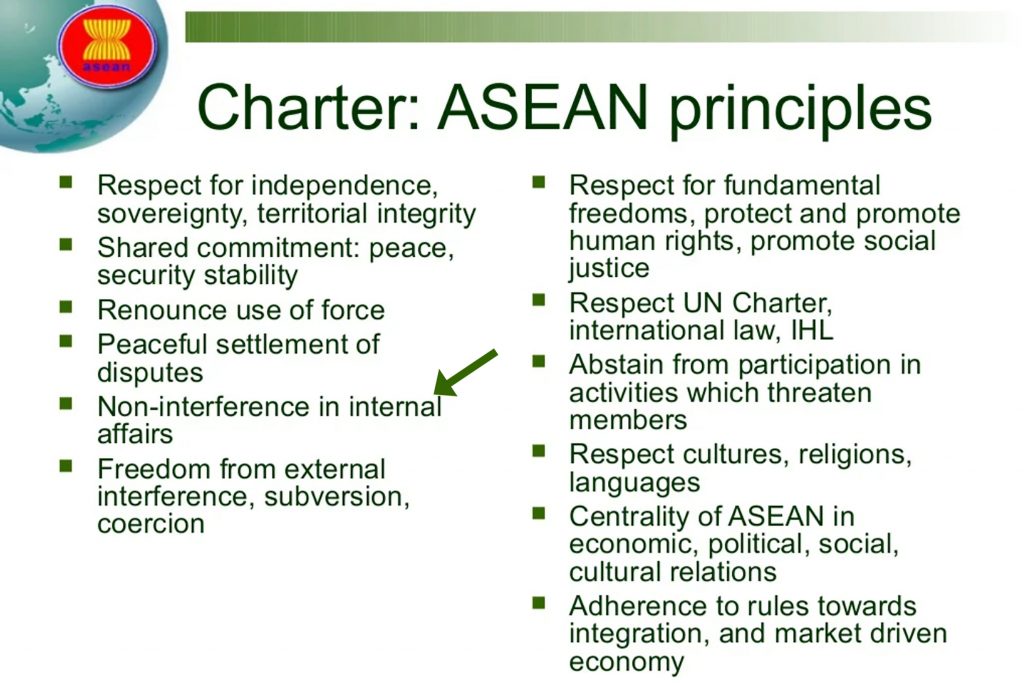
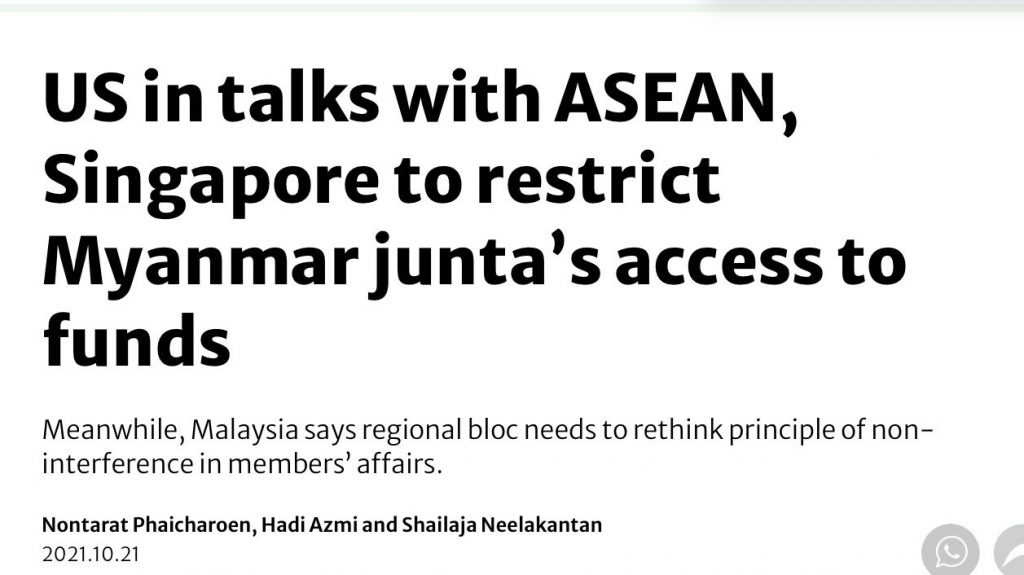
ASEAN was formed in 1967. Members signed the ASEAN Charter in Bangkok, legitimising the grouping. The Charter itself stood as a legally binding agreement among members. The salient points being to prosper based upon principles of democracy, rule of law and good governance. Plus a more critical, non interference in the internal affairs of others. Obviously the latter point has been a bone of contention between Myanmar and some of the more outspoken countries of ASEAN, especially when it comes to Myanmar.

Current Relationship

The current relationship between ASEAN and Myanmar seems to be basing on the fundamental belief that Myanmar military is good for nothing, ruthless, killing innocents, and the current government is doing nothing good for the country. The reality cannot be further from the truth. Without the military takeover on January 31, 2021, we would have a government in place through fraudulent elections and voters fraud, continuation of corruption at the very top level of the past five years (>90% of NLD ministers are now in jail for corruption!), brought the country down to a path of losing its national identity through uncontrolled entry of illegals from neighbouring state in the west.

Yet, ASEAN is doing as much as possible, at every single event to embarrass current Myanmar government. Unless Myanmar follows what the West and ASEAN dictate, they will not accept Myanmar in the current state.

The West and ASEAN continue to believe in the fake news put up by exile media and their related terrorist organisations (NNCP – NUG, NLD, CRPH, PDF), without any form of fact checking whatsoever. They are indirectly supporting the killing of innocent people and targeted assassinations, as these fake news facebook pages are filled people encouraging to kill and murder anyone who fight for the truth and consequently, not in line with their ideology.

In the middle of September, a retired military officer / an ambassador was assassinated in Hlaing township of Yangon by the terrorists. They have been watching his movements and his house for three consecutive days, before finally carrying out the murder. Even though the perpetrators are now in custody, it is an undeniable example of a net loss for Myanmar, where the life of an educated, learned person, who has contributed and who still can contribute to the nation, has to be exchanged with some terrorists who steadfastly believe killing only would help their cause for democracy. Exactly on the contrary. It is becoming unmistakably similar to BCP (Burmese Communist Party) actions of 1950s or the Pol Pot era actions of the 1970s. Through continued support, be it direct or indirect, of the terrorist organisations, ASEAN is contributing significantly to the instability and insecurity in Myanmar, while ridding of the talented and good people of Myanmar at the same time. Evidently, the ASEAN policy of constructive engagement is no longer on the table.

Anti Myanmar Push

Within ASEAN itself, two or three specific groups have evolved. The first group, distinctly anti-Myanmar, believes that the current government should simply give the power back to the party that has cheated in the 2020 elections, or at least negotiate with them, to put in a process to hand the power back to a corrupt government. They include Malaysia, Singapore, Indonesia and possibly Brunei. E.g., Singapore foreign minister has clearly stated that the country does not recognised the current government. Malaysia foreign minister has meet leaders of terrorist organisations as a show of support for these people, possibly to continue their terrorism activities in Myanmar. Indonesia parliament is also trying to put forward some actions to punish Myanmar, in the middle of September.

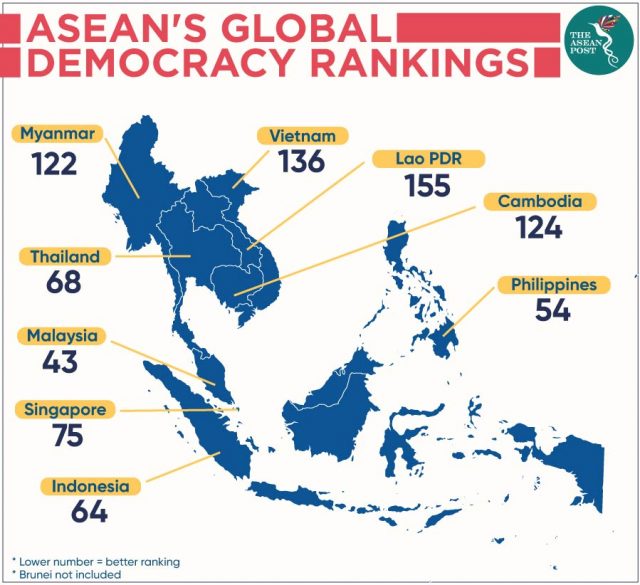
At every ASEAN meeting, Myanmar is neither invited nor invited in full. Yet, they be quick to issue statements and announcements admonishing Myanmar, or expressing statements of grave concerns for the happenings here. Yet they are the ones supporting the terrorist groups, at least indirectly. They talked about democracy in Myanmar, yet, a lot more ASEAN countries are less democratic than Myanmar. Think about private newspapers, or criticisms against leaders in some of these countries!

Some countries obviously sit on the fence; Thailand a prime example.

The rest of the ASEAN are in line with the principle of non-interference and would like Myanmar internal issues be addressed internally.

In addition to their support for illegal terrorist organisations, ASEAN seems to be acting as a lapdog for US. At the ASEAN summit and 121 meetings, US continues to push ASEAN, especially Singapore to restrict Myanmar government access to funds from its banks, with the sole objective to make the government fall. The very fact that ASEAN is allowing being dictated by the US worrying.

There are three reasons for this incessant anti-Myanmar push by some ASEAN countries: these country leaders being in good relations with the leaders of the previous corrupt government, some members being under the obvious influence of the West, especially the US, and due to lack of good communication by the current government, to the world on salient factual points.

How should we proceed?

Here, Sun Tzu’s Art of War would be handy.

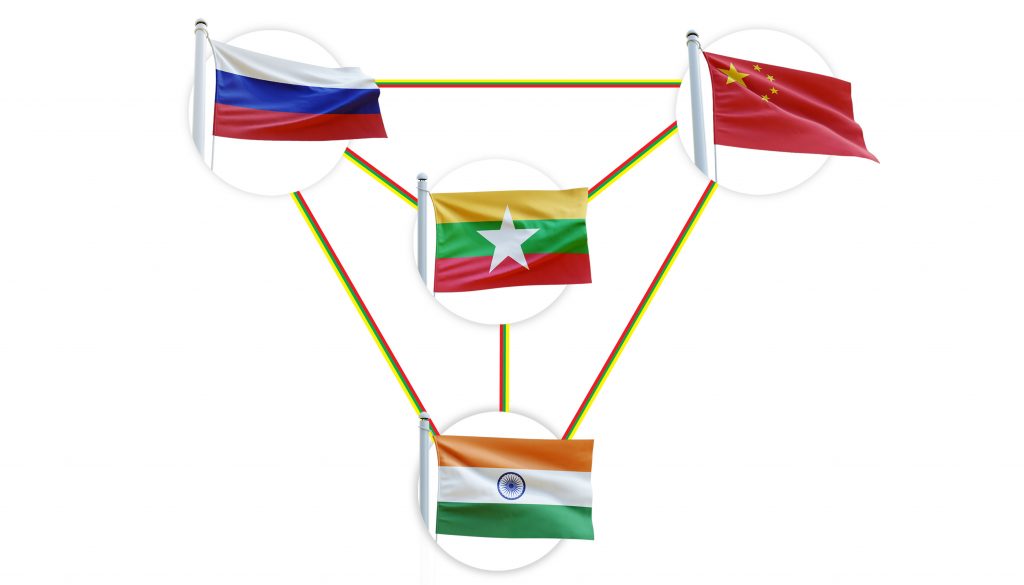
Sun Tzu said, “On the grounds of intersecting highways, join hands with your allies”. This the situation Myanmar is in now at the junction of intersection highways, both geographically and politically, with possible attacks on various fronts. And the government actions are in line with Sun Tzu’s recommendations. We have three very good allies, in the Bear, the Panda and the Elephant. China is already our largest trading partner and Russia and India would follow suit in no time.

“The best defence is a good offence”, is another Sun Tzu’s quote that Myanmar could use; by not being too defensive and let others bully. At this point of time, every single policy of dealing with the foreign countries seem defensive. Every week, MOFA would issue statements rebutting this and that, trying so hard to defend our position that sometimes, it even sounded desperate. We need to have our own line of attacks, rather than rebuttals all the time. Even China and Russia have their own channels in English, opening attacking lines upon US and the West, all the time now. We will never will anything just by being defensive.

The last action would be to communicate to the outside world in a language that they can understand. The objective was to have facts, evidences and truths to reach to the outside world. At present, the government held press conferences once or twice a month, yet everything explanations and QnAs are in Burmese language. Then the whole world have to learn from fake news media group to read news about Myanmar. Hence, the government must add on communication in English to augment the current plan, to positively convey the right messages to the outside world.

The Future

The country must move from a position of defence to a more offensive position. Because there are some people out there, who would bully us and talk bad about us, regardless of how well we do and how good our intentions are. Just think about this; if you got bully at school, would you just lie down and take it! As short as the last week of September, UN Human Rights Chief, as quoted as saying that upcoming Myanmar elections would be a fraud, telling everyone not to assist in the current government upcoming elections process.

This is the same UN, who refused to give a single doze of Covid vaccine to Myanmar in 2021, during our dark period of Covid. Talking about using healthcare as a political tool! Just to make the ordinary folks suffer. There are some elements out there who would want Myanmar to be cowed and fall in line with whatever they dictate.

Time to appease everyone all over the world is over. We have to do what is right for Myanmar. We cannot play defensive internationally and just be angels. Figuratively, both in English and in Burmese. (In Burmese, ‘Angel’ has the same pronunciation as being just loud at home and chicken out outside of your home)

Myanmar’s Art of War

In the world of strategy and strategic thinking, a legend was borne around the time of Buddha himself. To call that era the golden age of philosophers would be an understatement. Confucius, Lao Tzu, from the east and Archimedes, Aristotle, Plato, from the West are all borne around that era, between 500 – 300 BC. That legend was none other than the brilliant Sun Tzu.

Sun Tzu’s art of war was studied in the top military schools today. His strategic thinking was an elective subject in top MBA schools. In some countries, top brasses of the military have to go through a course in Art of War, just to get promoted.

At this very point of time, Myanmar is facing pressures from the West and ASEAN, the latter following an agenda and similar narratives of the West, based on fake news and mis-information. These fake news agencies, such as Khit Thit, Mizzima, Irrawaddy, created many fake stories, presented misleading information, as part of their payback for 20% share of terrorism campaign funds. 

“Know yourself, know the other side, you will not be defeated”, Sun Tzu said. Myanmar at this point of time is of limited power, influence and resources. Even our ASEAN neighbors, who signed a treaty not to interfere in each others’ internal affairs take advantage of this weaknesses, to put pressures upon us, through non-invitation to group events, regularly issuing statements of utmost concerns, not treating us as equals in meetings, announcing declarations just to embarrass us, etc. Some countries such as Malaysia, went as far as, blatantly showing support for the terrorist exile government. When the narratives that arise out of facts, figures and evidences are not up to the liking of the West and the fake media groups, they resort to the attacks of the characters, name callings and slander of the current administration and Myanmar leaders. Yet it is best that Myanmar does not appease these other sides, all hell bent on making sure the corrupt NLD government comes back to bankrupt the country and run to the likes of the Western world. Our sovereignty is at stake here.

Taking another leave from Sun Tzu’s book, “Do not enter into alliances until we know the design of your neighbors”. Design here means the internal workings, plans, objectives, strengths and weaknesses of our neighbors. E.g.,  the basic designs of Bangladesh and Myanmar are so different that we can never be allies.

“On the grounds of intersecting highways, join hands with your allies” was another of Sun Tzu’s famous quotes. Myanmar is at the point intersections of geopolitical highways, due to its location. The interests of many powerful countries are being contested here. In such instances, it would be wise, as Sun Tzu suggested to ally with some of them, to strengthen our nation. The current allied movement with Russia is one of the best move of the current administration. Myanmar and Russia interests are very much intertwined now. With very good existing relations with India and China, Myanmar can strive towards economic development, without heeding to incessant threats of western and ASEAN sponsored sanctions. Those who followed the meeting between UN Special Representative and Senior Gen Min Aung Hlaing, would note that Myanmar leader has not forgotten the fact that WHO has not provided a single COVID vaccines in the period of utmost medical need in Myanmar, in 2021. A sad example of how world organizations being used as a tool to further political agenda of the West.

In addition to Sun Tzu, Myanmar also has its own strategy for use in difficult times: “When the English are in difficulties, it is a point of advantage for the Burmese.” The saying came about during the fight for independence, when the English were having a difficult time during the WWII, Myanmar independent fighters went to Japan secretly to ask for help, asking the Japanese to come and fight the British out!” The same strategy can be applied here. At the time, when the West is busy with economic, energy and Ukraine crisis, and at the time, when ASEAN unity and support is an all time low, now may be the time to completely rid ourselves of dependence upon them. Self sufficiency and cementing further strategic alliances with the Bear, the Panda and the Elephant would probably be recommended by Sun Tzu, too.

Latest Videos

Interview with Alison Fox Principal of The British School Yangon

Interview with Alison Fox Principal of The British School Yangon

Recent Posts