Home Blog Page 239

How to Avoid Buying Fake Rubies and Sapphires

The market for gemstones in Myanmar is one of the most vibrant and active in the world. Our natural resources have long been renowned for their quality and desirability. In particular, rubies and sapphires both come from the corundum family, with rubies being red and sapphires being any other colour but red. Rubies exhibit the “asterism” effect, better known as the “star” effect, which is one of their most prized characteristics. Natural rubies come in red, blue, purple, pink, white (clear), gray and black (both silver and gold stars).

With exciting new times in Myanmar come exciting new opportunities, and I have been speaking to an increasing number of people in the country recently who are considering making an online gemstone purchase to compare markets. There are certain things that you will need to consider, as the online market for fake gemstones is on the rise, even on the more reputable and popular sites like Ebay.

1) Ensure that the person you are buying the gemstone from has a good return policy.

2) Bear in mind that the colour of the actual gemstone will almost certainly not have been accurately reproduced neither by the camera nor the computer screen on which you are viewing it.Each computer screen is different in terms of its calibration and some online sellers have been known to digitally enhance the colour of the piece in order to increase its desirability.

3) Make sure that you check the Feedback section of the seller/store’s account. This is extremely important. If there are a large number of comments, you can use filters to select negative or neutral comments.

As I said, our domestic market is extremely exciting, to say the least, and in such a market there will always be those who wish to defraud consumers by counterfeiting desirable items. A major problem that stems from such an industry with regards to rubies and sapphires are the synthetic or “lab grown” stones, often referred to as “manmade”. In terms of the online market, there are probably more manmade corundum stones on sale than there are genuine articles. Key to spotting such items is looking for an overly transparent stone, in which the star is easy to define. In most cases this is indicative of a manmade ruby or sapphire.

There is also a treatment done to natural stones called “diffusion”, which improves asterism to make the star easier to see, but most stones that have been diffused are much darker and more opaque. As mentioned earlier, genuine rubies and sapphires come in a variety of colours, but synthetic varieties only come in red and blue.

Other stones on the market (including Star Garnets, found mainly in India and the state of Idaho in the US) are occasionally mistaken for rubies or sapphires (and can be used fraudulently as such), but they generally have fewer rays, which is the most effective method of determining the difference (garnets having four to six rays, corundums having six to 12 rays).

Hopefully this quick guide will save you the trouble and embarrassment of making a risky yet avoidable online purchase. With a bit of vigilance and due diligence, the internet is a safe and often preferred means of shopping.

Luxurious Indulgence

Floating like a balloon and as blue as the sapphire safely nestled in its side, the Ballon Bleu watch by Cartier adds a dash of elegance to male and female wrists alike. Roman numerals are guided on their path by a sapphire cabochon winding mechanism protected by an arc of precious metal. With the convex curves of the case, guilloché dial, sword shaped hands and polished or satin finish links of the bracelet, the Ballon Bleu watch by Cartier floats through the world of Cartier watchmaking. Cartier Ballon Bleu Large 18k Yellow Gold Mens Watch has 42mm case diameter, 11.9mm case thickness, 18k yellow gold case with 18k yellow gold bracelet, fixed 18k yellow gold bezel, silver dial with blue steel hands and Roman numeral hour markers, minute markers around the outer rim, date display at the 3 o’clock position. In addition, self winding automatic movement, scratch resistant sapphire crystal, 18k yellow gold crown, solid case back and water resistant at 30 meters/100 feet, functions give it more royal look. Price: US$39,800

Samo is the newest Omas limited edition, which represents a tribute between the cultures of the East and West. It celebrates the origin of ideas from the 6th century BC when the island of Samos was at the peak of its role as a point of exchange of goods. Samo, a fountain pen by Omas, underlines the first steps of the visual signs left by the Hellenic civilisation combining luxury, culture and design. The clip, elongated beyond the cap and bearing the engravings of Omas and Samo, represents the idealised bridge uniting East and West. Made in a numbered certified limited edition of 572 pieces in solid silver; 572 represents the birth year of the famous Samos son, Pythagoras. Also available in solid Rose Gold with diamonds on the clip – 14 pieces. Price: US$3,400

Hanthawaddy Airport Project Delayed

Negotiations for the contract to build Myanmar’s Hanthawaddy Airport, originally granted to a consortium led by South Korea’s Incheon Airport, has fallen apart, and the license is now up for grabs again.

Incheon won the soughtafter tender in August, with three other consortia, led by Singapore’s Changi Airport Planners, France’s Vinci Airport and Japan’s Taisei Airport, selected as backups. Negotiations with Incheon never materialised and now all four consortia are being asked to resubmit their financial proposals.

“They don’t need to resubmit their existing technical proposals on design, construction, operation and maintenance”, U Win Swe Tun, deputy director general of Myanmar’s Department of Civil Aviation, said. The new deadline will be April 22nd.

“For these reasons, the December 2016 completion date cannot be met”, he continued. “The project starting date and completion date will be announced in the near future after selection of the winning consortium”.

The new airport will be located on 9,000 acres about 48 miles outside the commercial centre and former capital of Yangon. Construction began in March 1994, but long stagnated and halted completely in October 2003. The airport is projected to have an annual capacity of 10 million passengers.

As Hanthawaddy has been pushed back, however, Myanmar’s international passenger traffic will continue to be handled at Yangon International Airport, which will increase capacity from the current 2.7 million passengers per year to 3.5 million by 2015, and 6 million by 2019.

Business Law: Band 1 in the 2014 rankings from the internationally recognised legal directory Chambers Asia Pacific.

In this year’s edition, Chambers Asia Pacific says about DFDL in Myanmar: “This is one of the longest running practices in Myanmar, and is consistently regarded by clients and peers alike as a preeminent firm with a developed practice in all areas of commercial law. The firm’s breadth of experience has stood it in good stead to handle work from a wide range of important emerging sectors in the country”, and peers note: “They’re strong on energy and infrastructure matters. It is affiliated with regional firm DFDL.”

James Finch, Partner and Managing Director Myanmar, said: “This honour has meant so much to us. Much of what we have been able to accomplish in recent months and years has been due to the tenacity and collaboration of our clients, who have supported us all the way”.

The Image of Women in Myanmar Art

Female artists seem to dominate art festivals and galleries in Myanmar. They are champions of the age of female empowerment. Not to be forgotten is Aung San Suu Kyi, one of the most respected women in the world’s public eye; she alone gives cause to the fight for equality. Why is it, then, that many women in Myanmar do not associate themselves with the word “feminism”? At the recent “Image of Woman” exhibition, held at the French Institute in Yangon, four female filmmakers sat on a panel discussing their contribution to the industry. When the moderator asked whether they considered themselves feminists, all four women replied “no”, they were not feminists. To paraphrase, they described their status in society as being equal to that of men and that, individually, they have never experienced discrimination because of their gender and, therefore, they did not feel the need to be considered male or female, but simply human.

Just the night before, at the same exhibition, a female writer from Myanmar was invited to speak about discrimination against women in the country and discuss what could be done to stop it. She mentioned that women are required to have higher marks than men in order to be accepted into university. She went on to describe the widely held belief that women do not need to be educated, because they are meant to raise children in the home. How do we change this belief? The Myanmese writer stated that she believes women need to create civil society organisations to promote equality, as well as encourage religious leaders to promote the roles of women – both in the home and the workplace.

From the point of view of this writer, discrimination exists and must be confronted. The filmmakers also agree that discrimination exists, but they believe they have never experienced it. A parallel can also be seen among female visual artists in Myanmar and the work they create. While some directly question the roles that male dominated institutions have assigned, others choose to take a more humanist approach and conciliate that men and women suffer the same fate. Take, for example, the incomparable Ma Ei, a performance artist whose practice has evolved over the last five years into a direct confrontation with men in society. A few particularly memorable performance pieces occurred at the “Beyond Pressure Performance” art festivals in 2011 in Yangon and Mandalay. In the first piece, on the grassy hill of the Say Lan Soe Pyay gardens, Ma Ei put on a men’s longyi and began to cook noodles for the audience. A very simple act, though it may seem, it raises a wealth of questions on what is and is not acceptable in the society in which the artists lives: women wearing men’s clothing, men cooking in the home, etc. That same year in Mandalay, part of her performance entailed applying nail polish and spraying perfume on a male audience member. What happens when artists begin to beg the question: where does the bridge building equality in the artwork exist in the society in which we live?

Many young artists have taken note of Ma Ei’s strong performance art pieces. In September of 2012, Yadanar Win – a young protégé at the New Zero art school in Yangon – painted the nails of male audience members “in a commentary on restrictive gender roles”. This is not a case of who copied who, but who was influenced and found strength in artistic communication. Female artists in Myanmar create their own civil society, making visual the discrimination that women all over the world face on a daily basis.

Artist Zoncy also shows her strength through works relating to women. Her recent photographic portraits at the “Image of Woman” exhibition looked at women in the countryside who work alongside men and take care of the family. Each woman wore a traditional hta mainn pulled up around her chest; each head was a piece of fruit; each body walked through rice paddies or farmed fields. Some women walked together, some alone. Zoncy’s major focal point exists outside of Yangon, being from Southeast Myanmar as she is and moving to Yangon only for her education. Preferring to relate to those women whose work directly correlates both with nature and the female spirit of family and providing, she is one of the few artists who feels free to call herself a feminist, and points out that men should, too.

Nge Lay, an installation artist and photographer, experiences a different kind of female identity; one relating to power that is both gained and lost when a woman experiences pregnancy. Phyu Mon, part of an older generation of female artists, also concentrates on the difficulty women in society face as wives, mothers and teachers. Sandar Khine, Zun Ei Phyu and Mor Mor are painters/mixed media artists who all represent some part of “femaleness”; not by questioning their relationship with men, but by looking inside themselves for answers to their insecurities, their confidence or their tears.

So many dozens of other female artists, writers and parliamentarians (and any other number of positions) live and work with and alongside men, considering themselves equal to any task. No doubt there are men who support the elimination of discrimination, while also considering their female counterparts equal, but the work is not yet done. If it were, there would not be the need for the Image of Woman panel discussions and exhibitions, nor the artwork that questions the roles of women among men. Perhaps the word “feminism” is too limiting or it does not hold the same meaning as it does in other parts of the world. The role of women in any society is upheld by the men and women in it. However, if the women with considerable amounts of power, with a distinctly louder voice, can share more through their creations – be it film or poetry, family or career – women in societies all over the world would take note and feel free, knowing that theirs is a universal struggle in solidarity.


Modern Farm Tech

In a world where technological advancements happen on an almost daily basis, what does modern global agriculture have to offer the producers of Myanmar today? Let’s take a closer look at my top five that, while they may be on the distant horizon for our local agriculture industries, they certainly give us something to look forward to. Ladies and gentlemen, welcome to the future.

Tractors on Autopilot

Tractors, combines, sprayers and an increasingly wide variety of modern farming equipment can accurately navigate through fields on autopilot. Thanks to GPS technology, the user (farmer) has to program the onboard computer with the relevant information on the area to be covered for a particular task and the GPS system will track and monitor the vehicle as it extrapolates a path into parallel lines, taking into account the width of the tool in use. Not limited to straight lines, the tracking system controls the vehicle’s steering system, keeping it on a true path and negating the need for a human operator, who can concentrate on more important things – it can even remove certain aspects of human error from processes, while economising fuel and vehicle usage hours.

Telematic Tractors

Allowing equipment to communicate with farmers, equipment suppliers and servicers and even other equipment, telematics is considered the next big thing in the industry.

Consider this scenario: There is a problem in the field and work must stop. This new technology can use its onboard diagnostic systems to identify the problem and will contact the manufacturer and/or servicer and relay the relevant information so that a solution may be found. In many cases, the problem may be resolved remotely, which saves time, travelling and money.

Farmers are also now able to track which equipment is in which field, vehicular hours of operation and fuel consumption and much more. Tractors are now able to communicate with one another, a prime example of which is a combine and a grain cart; the cart can pull up beside the combine to transfer the load without having to stop. The same technology can then inform the operator that the cart is full, which can be particularly useful when using one cart and two combines.

One of the most recent innovations related to this technology is the ability for the operator to take wireless control of the cart as it drives alongside the combine in order to make minor adjustments to the cart’s path for a more effective transfer.

Smartphone Irrigation

Mobile technology is playing an increasingly important role in the controlling and monitoring of crop irrigation systems. A farmer can now control his entire irrigation system remotely from a smartphone or computer.

Moisture sensors placed in the soil transmit data about current moisture levels at various depths in the ground. More precise control over inputs like water and fertiliser are applied by irrigation pivots, which can be combined with other tech (such as VRT) to control the rate at which inputs are applied. The entire concept is receiving positive reviews for its effective and efficient use of resources; because of such technologies, total water usage could potentially be lower than the amount of water previously wasted, which is extremely significant in terms of water conservation.

Livestock Upkeep

Modern ultrasound technology can not only be used to determine characteristics of unborn animals, it can be used to check the quality of meat before the animal goes to market. Animals with desirable qualities and good pedigree can be identified prior to birth via DNA testing, which can provide information that can be used to improve the herd quality and the farmer’s bottom line.

Crop Sensors

This groundbreaking technology allows crop sensors to tell application equipment in real time how much fertiliser needs to be applied. Optical sensors can scan plants to determine how much fertiliser is needed from the amount of light being reflected from the plant.

Crop sensors are a new technology, but the potential is extremely high. Farmers are now able to apply fertiliser in an incredibly effective manner, maximising uptake while reducing runoff into ground water and potential leaching.

Definitely something to look forward to.

The State of Tourism

Long before the country was a “no go” area for most international tourists, Myanmar long attracted visitors captivated by its beautiful landscapes, strong history and culture and easygoing, friendly locals. It was inevitable, then, that when the government began introducing reforms that would see the country go from pariah to darling in just a few short years, that the visitors would come flooding back.

In the 2013 calendar year, visitor numbers to Myanmar reached upwards of two million for the first time, almost double the number that had arrived the previous year. The Minister for Hotels and Tourism, U Htay Aung, has already stated that the ministry is aiming for three million visitors by the end of this year.

It is hardly surprising, then, that in the major destinations – namely Yangon, Mandalay, Bagan, Inle Lake and the beach resorts of Ngwe Saung and Ngapali – hotel managers and owners have seen the prospects on offer and hiked their prices accordingly. According to some figures, hotel occupancy in the most popular areas is upwards of 75 percent, compared to less than 40 percent in even the most popular beach destinations in neighbouring Thailand, and some of the most high end hotels in Yangon have upped prices by almost 500 percent since 2011.

Yet, few of the hotels are investing the extra cash into improving customers’ experiences, meaning visitors are paying over the odds for rooms that are not of the standard of cheaper rooms elsewhere. In the last year or so, international hotel brands including Novotel, Best Western and Hilton have announced that they soon plan to begin ventures in the country and many smaller entrepreneurs are exploring the option of starting their own smaller hotels. Those that are happy to collect their cash and sit on it, rather than upgrade and improve, will only lose out when this happens.

The price hike is causing problems for tour operators in the country, too. One unnamed tour operator said that there have been a number of incidents where they have booked hotel rooms for a group tour in Yangon months in advance, only to be told, upon the group’s arrival, that the reservations were cancelled and booked for another group who were willing to pay more.

“Hotels are really greedy. They charge US$150 a night for a room that is worth only US$40… complaints from travellers about poor facilities are increasing, causing potential damage to the image of the country,” another travel company said.

There are other challenges to be met, too. With development comes profit, and that can often lead to the potential loss of culture. Myanmar has a remarkably strong and unique culture that is never likely to disappear entirely, but as the country develops, there is the risk that certain elements of traditional heritage will fall away as gentrification inevitably descends on the country.

At Inle Lake, among the “Big Four” destinations that most visitors to Myanmar see, a group of local people are working to try and ensure that their unique heritage remains intact.

Despite being in Shan State, the majority of people living on the lake are of the Intha group of people. Their lives and customs generally revolve around life on the lake and the Intha Heritage House has been set up to preserve this heritage as more international businesses look at the area due to its huge potential.

Currently, there are just a handful of locally owned hotels in and around Inle Lake and, while this has been helped by the government ensuring that no international companies can begin tourism ventures completely on their own, there is still a risk that the money being made by the larger companies in Inle Lake will not pour down into the community.

Some of what the Intha Heritage Group have done has included breeding Burmese cats and opening an aquarium that conserves the fish that are indigenous to the lake, but the majority of their work comes from ensuring that those international companies ensure that what they do is sustainable.

“If they [foreign run hotels] want to sustain their businesses, outside investors should take care of the local community. If Inle is no longer attractive to tourists, no one will come, no matter how much you have invested,” Daw Yin Myo Su, the Intha Heritage House founder said.

Inle Lake is a well established tourist destination within Myanmar, having been on the map long before the country opened up, but other newly emerging destinations with their own unique heritage have their own challenges to face.

In the south, there are the water dwelling Moken people who are likely to suffer if the Mergui archipelago emerges as a tourist destination of the repute that some are tipping it to, while in the far north there are the fiercely proud Kachin. Ongoing conflict in the state means that it is unlikely to emerge as a tourist destination in the near future but, if and when it does, lessons can be learned from other groups that have gone before them.


Myanmar Moves to Broaden Tax Base

In Myanmar, as in many nations with developing economies, tax evasion and illegal border trade is rampant. Such practises have essentially become institutionalised through the almost complete lack of enforcement of existing tax laws and the failure to punish those who have clearly avoided or evaded paying the proper amount of tax. In practise, income is often not reported or is well underreported. In the case of rental income, for instance, a practise has developed whereby two contracts will be drawn up, but the income received under only one will be reported to the tax authorities.

In an effort to curb the abuse of the tax system and increase tax revenues, the Pyindaungsu Hluttaw recently drafted a Union Tax Law, which was set to go into effect as of the 1st of April. In large part, the new law is simply a codification of regime that had previously been implemented through ministerial notification, but there are some changes to be aware of.

Income Tax

The published draft generally does not substantially depart from the current income tax rates. Under the draft, salary income tax rates remain at: one to 20 percent for resident individuals; 35 percent for non resident foreigners; 25 percent for resident companies; and 30 percent for undisclosed income. “Other income” will be taxed at two to 30 percent, but the rates governing professionals and income from property have not been clearly provided for yet.

The current tax exemptions and deductible allowances for resident individuals have largely been preserved, as well. The deductions from income when a taxpayer has a spouse and/or children were maintained at the current levels of 300,000 kyat for a spouse and 200,000 kyat for each dependent child. However, the monthly threshold requiring the payment of income tax has risen from 120,000 kyat to 160,000 kyat – i.e. low wage earners do not need to pay any income tax.

An additional “income tax” of ten percent will now be levied against “income used for buying, construction and taking possession” of capital assets (including shares of a company). This will be chargeable to the buyer for spending rather than earning income, meaning honest tax payers may end up paying tax on their income twice. This is a major departure and is generally a very unique provision. As mentioned, tax evasion has been a major issue that Myanmar has struggled to curb, so this is a way for the tax authorities to get another bite at the apple, as it were. As for the seller, the Union Tax Law retains the capital gains tax rates of ten percent for residents, 40 percent for non residents and 45 to 50 percent for those engaged in the oil and gas industry.

Commercial Tax

In addition, the draft 2014 Union Tax Law retains major aspects of the current Commercial Tax (CT) regime. The CT rate remains generally at five percent, but the scope of CT on services has expanded considerably.

Under existing law, only 14 types of services are covered by the CT Law. The new tax law now states that all services are subject to CT, except as may be provided for by the Ministry of Finance. We understand this to mean that all types of services, unless specifically exempted, will be subject to CT moving forward. Service providers that have, or anticipate having, annual revenues in excess of ten million kyat (approximately US$10,000) will have to charge CT on their invoiced amounts. If a service provider has annual income below ten million kyat, there is no need to charge CT.

The regular rate of five percent CT will also apply to importers and sellers of goods whose annual revenue exceeds ten million kyat. There is a slight reduction in the number of goods on which CT is levied, although there are fewer goods subject to the higher rates of eight percent to 100 percent.

Moving Forward

The idea of broadening the tax base is a wise one, however, many more changes are needed. Enforcement by tax officials and voluntary compliance by individuals must improve. The government recently released a list of more than 10,000 businesses said to be evading taxes. This “public shaming” may push some businesses to comply with the tax laws moving forward but, with tax evasion so engrained in the collective mind of Myanmar citizens, more may need to be done, as well. Education is the key, both of the tax officials and the tax payers.

The approved bill is still subject to signature or veto by the President, but it is anticipated that he will sign it into law later this month.

The Governor’s Residence

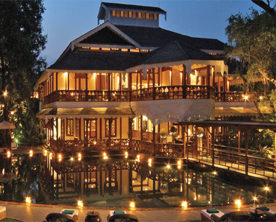
Once home, as the name suggests, to the governors of the British Crown Colony of Burma, such as Sir Reginald Dorman-Smith (Governor from 1941 to 1946) and Sir Hubert Rance (1946 to 1948), there are few more beautiful spots in Yangon to enjoy a meal.

Set on beautiful grounds in a leafy area west of town that was once home to the higher echelons of the British administration in the country, the Governor’s Residence Hotel is set in an elegant teak mansion built in the 1920s. The Mandalay Restaurant sits on an attractive veranda that overlooks the hotel’s pool and a green lawn that has peacocks roaming on it. The hotel also hosts dinners on the lawn itself.

With its Kipling Bar downstairs,which includes the Kipling Sling cocktail, here is a place that celebrates the country’s British past and, as one might expect, it is one of the more expensive options in town. Just around the corner is the now derelict Pegu Club, which was once colonial Rangoon’s version of the famous Raffles Hotel in Singapore.

There has been a slight change in menu recently to give the restaurant a more local feel, and one of the highlights offered is the Burmese Curry Table, which offers local curries, vegetables and rice served buffet style over charcoal.

While the majority of the menu is of local origin, those who are not too keen on the hot tang of Asian food can opt for less spicy options, and there is a fine selection of desserts.

While it is pricey, for those looking to impress a client, or a date, there are fewer more charming spots, and it’s the perfect finish to any evening with a refreshing cocktail.

Life Downtown

Roaming around Yangon’s downtown area over the past year has become one of my life’s little pleasures.

The aromas from the street food restaurants, combined with the buzzing chitchat of the locals, adds greatly to the atmosphere of what has become my favourite pastime in my favourite part of town.

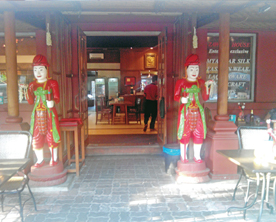
Seeking out new places to eat, drink and people watch is what life in this part of the city has become for me and my small group of friends.One restaurant that we regularly go back to – because it really is very good – is the Zawgyi House Café, just along from Boyoke Market.

It serves a delightful mix of French, English and Myanmarese food and wines that I simply can’t find anywhere else in town. The location is great, and the al fresco terrace is unbeatable for sitting, watching and appreciating Yangon’s daily life at its most charming and very best.

An early morning breakfast of fresh home baked baguettes filled with tomato and salami and served with a hot latte is a true delight. If you’re around at lunchtime, give one of the pizza’s a try for just K8,000 and wash it down with a cold Dagon beer for K2,500.

Yeah – sitting on their terrace isn’t too bad…

At night, as the sun sets over the city and a different crowd start wandering by, the restaurant lights with a maze of colour and the fine selection of wines from Italy, France, Argentina and Myanmar start to come into their own.

Life DowntownBy Anthony ParkerSome good Pinot Noir, Shiraz, Muscat and Macon wines are all on the list and prices vary around the K20,000 range. They all go nicely with my favourite chicken cordon blue, which only costs K7.000. The grilled pork chops and steaks with fresh salads and fries are delicious and are nicely complemented by a Myanmar Pinot Noir at K30,000 or the French Cote Du Rhone at K31,500, which is the most expensive wine on the menu.

If you’re in the mood for a dessert, look no further than the selection of ice creams at only K4,000-4,500 to round the meal off nicely.

When I was there last month, one of the waiters told me that they are opening a new restaurant called L’ Alchimiste on U Tun Nyein Street, Mayangone, in a beautiful old colonial building, and that they might be closing the existing one down; there are a lot of people who really hope they don’t – and it’s certainly odd to do a review of a restaurant that, at the time of this writing, might be closing… but I have done so in the hope that they’ll stay open.

Even if they don’t, we will just have to head over to the new location and keep sampling their delicious fare.

Publisher, Agent, Distributor and Authorised Issuer of ISBN Numbers in Myanmar

Name: U Myo Aung

Job Title: Entrepreneur

Age: 53

Main Companies: Pyi Zone Publishing House,

Success International Publisher’s Distributor

Profession: Publisher, Distributor, Writer.

The Myanmar Insider: When did you start your first business in Myanmar, and is it still operational today? If so, how has the business model changed from when you first started?

U Myo Aung: My father was a high school teacher and we were not well off. My father encouraged me to learn English since I was very young. He also enrolled me for Burmese tuition classes since 8th standard. Hence, I have read both English and Burmese publications widely and extensively since a young age. I developed good writing skills, too. My first proper writing for publication was in 1989 when I wrote for Moe Wei Magazine, a short translated biography of Randy Travis, a celebrity. I started my writing career and, before long, I was already writing for Myanma Dana (a local business magazine), as a monthly featured writer. From 1992 to 1994, I was in Singapore. I attended a business school there. When I got back to Myanmar in 1994, I started to cooperate with Innwa Bookstore. Under Innwa operations, we started importing and distributing foreign publications, such as books, newspapers, etc., starting with Singapore papers from SPH (Singapore Press Holdings). Shortly after, we began distributing IHT (the International Herald Tribune), too. Towards the end of 2005, it ended up with Innwa Bookstore taking care of international magazines and me taking care of international newspapers, under a new entity, Success International Publisher Distributor Co Ltd. The model has not changed much since then. In April 2013, when the new Myanmar government allowed the publication of private newspapers, we also decided to print IHT locally. The IHT system is such that it is possible to print and make available every morning the same newspaper in 180+ countries. The actual printing of the first set of IHT in Myanmar was on September 25th, 2013. IHT became the International New York Times (INYT) on October 15th, 2013.

MI: What is your role as agent for the INYT in Myanmar?

MA: Quite simple, actually. I am responsible for printing, marketing and distribution of the INYT in Myanmar.

MI: Could you share with us the story of how you managed to link up with the internationally renowned newspaper?

MA: It started in 1994, when one international correspondent from IHT visited Myanmar, wanting to write about the country. Innwa Bookstore was given the opportunity by the government to bring him around Myanmar. In return for the permission, IHT started to provide free copies to senior officials within the government. 1995 was the famous “visit Myanmar” year. Hotels needed newspapers and we asked for permission to distribute IHT to these establishments and permission was granted by both the government and IHT.

MI: How did the previous press laws and lack of press freedoms affect the distribution of the INYT in Myanmar?

MA: Previously, the press was controlled via the 1962 Press Registration Act. Everything was reviewed and censored. Every single imported publication had to pass through the Press Scrutiny Department for approval. The news, articles or images of any kind that were against Burma were torn or cut from pages, resulting in many complaints by subscribers (foreigners). It got especially worse if the censored story was the cover story. Then the whole publication is not authorised for distribution. I remembered making thousands of losses compensating the subscribers and having to pay the publisher. In 2005, the Press Registration Department started to relax some controls, with lesser censorship rules. It was not until 2011 under the present new government that the whole censorship policy was abandoned. We currently do not have any censorship on any news. We just have to provide 12 copies of our publications daily to the Copyright and Registration Department.

MI: What are your plans to localise the INYT?

MA: Based on our agreement, I need to increase circulation, i.e., marketing. I also intend to form an editorial team under INYT supervision in six months time. The objective is to be able to put in two to four pages of local news within the main paper. Of course, we have to meet INYT editorial standards. This is part of our agreement.

MI: How does the International Standard Book Number (ISBN) system work in Myanmar, and what is your role as the agent of ISBN here?MA: For Myanmar books to sell overseas, first we must meet the international standards. This requires every book to have an ISBN number. Actually, the issuing agent is the Myanmar Publishers and Book Sellers Association. I am the vice chairman there.MI: Other than the INYT and ISBN, what are your principal business activities?

MA: I have Pyi Zone Publishing to publish books. I decided against diversification, as I wanted to become a well respected professional in my field.

MI: As Myanmar was a closed country for almost 50 years, what are your thoughts on the new found press freedoms going forward?

MA: Having a responsible and vibrant media is the fourth pillar under our government approach to democracy and democratic reform, but we have to build it ourselves. We have now enormous freedom of press and speech under the new government. At the same time, there are lots of weaknesses in the media industry itself. Responsible media is not there yet. Ethical journalism is still a distant target; codes of conduct, press council ethics – we are still in infancy. We are supposed to provide constructive criticism to the government and bring evidence based news stories to the people, rather than the current state of affairs of some papers, printing hearsay stories and personal attacks for political gains.

MI: In your opinion, will the young generation be interested in print media? What is your strategy to counter the increasing popularity of online materials?

MA: Currently almost all print is in hard copy version for our publishers – the audience is moving to online media. The main issue that we face due to this is the copyright issue. When a book is published in the morning, it is being shared freely online by the evening. Both publishers and writers earned nothing. We are planning to officially put our books online; Myanmar publishers, a book sellers association and an internet wallet company through the use of payment engines, such as ipay and Mobile Money, to sell their books online.

MI: Do you see any of your main business interests having to change or adapt to Myanmar’s new trends and its opening up to international markets?

MA: We all have to prepare for the change. In fact, changes are already taking place. It is a matter of time before foreign publishers and distributors come in. We also have to be geared towards copyrights. The copyright law is coming in very soon. I have heard of some sectors calling for protectionist measures; for me, I think of cooperating with foreign parties for mutual benefits.

MI: With the benefit of hindsight, would you have done anything differently when you started, and if so, why?

MA: I would like to continue working – continue to publish and contribute back to society – I also want to continue learning and sharing knowledge. As such, I would love to have taken better care of my health previously.

MI: From a business perspective, what do you feel are the biggest challenges facing you or your organisation in Myanmar in the next one to three years?

MA: Change of mindsets, business structures and operations are required to adjust to teaming up with international players. I also feel that we need to ensure laws and regulations continue to operate well.

MI: How do you see Myanmar comparing with its Asian neighbours in the short and long term future?

MA: Many printers and publishers from Thailand, Singapore and even Vietnam are looking for local print jobs. They have better banking facilities for finance and better SME support. We have to be better in these areas to compete with them.

MI: If you could make one major change in the country, what would it be?

MA: We need to reduce red tape and increase the flexibility of doing business here. The government could move more into online mode, standardising rules and regulations, thereby reducing transaction costs for entrepreneurs.

MI: What advice would you give to publishers looking to distribute their printed materials in Myanmar?

MA: The key, I believe, is the distribution network. We need to combine publication with distribution strategy. The second point would be to cooperate, instead of compete, for industry development. There is a saying in Burmese: “Loke Ngan To Yan Thu Phit”, which means “people doing the same kind of business become enemies”. We want to avoid that and work together for industry development.




Latest Videos

Interview with Alison Fox Principal of The British School Yangon

Interview with Alison Fox Principal of The British School Yangon

Recent Posts