Home Blog Page 238

Myanmar’s border trade reaches over 4 Billion US Dollars in 2013-14.

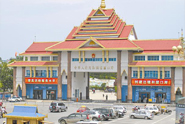
Myanmar’s border trade hit 4.585 billion US$ in the fiscal year 2013-14, this figure is up by over 830 million dollars compared with that of the same period of 2012-13 fiscal year, local media have reported.

Of the total, export stood at 2.75 billion dollars while imports were at 1.82 billion dollars. Myanmar’s border trade is conducted through 14 points with four neighboring countries, namely China, Thailand, Bangladesh and India. Of these, China is leading in Myanmar’s border trade. In a bid to promote border trade with neighboring countries, more border trade points will be opened to China and Thailand.

According to the Central Statistical Organization, foreign trade totaled 22,757 million dollars, with export amounting to 10,225.12 million dollars and import standing at 12,532 million dollars in the first 11 months (April-February) of the fiscal year 2013-14.

China’s 2014 auto sales set to surge

China’s automobile sales will rise by 8 to 10 percent this year to a new high. As many as 24.18 million vehicles may be sold in the country this year, according to a report released by the China Association of Automobile Manufacturers (CAAM).

Shi Jianhua, deputy secretary-general of the CAAM, said that demand will be boosted partly by China’s urbanisation push and upgrades in consumption patterns, though a number of big cities facing congestion and pollution problems have rolled out measures to restrict auto purchase.

China has been the world’s largest auto market and producer for five consecutive years, with sales and production now both exceeding 20 million units for the first time in 2013. Sales have risen by 13.9 percent to 21.98 million vehicles.


Myanmar’s border with yunnan known as a ‘museum of biodiversity’

A new reporting project to explore China’s biodiversity has begun its journey from Beijing to the Gaoligong Mountain Range in southwestern province of Yunnan on ‘Earth Day’, as part of a new project to record and promote Chinese biodiversity with writing and photos.

“Colorful China,” the program which sponsored the team, was jointly launched by the Xinhua News Agency and the China Green Foundation. This will be the first of a number of such trips, with the resulting travel logs to be published on www. icrosschina.com.

“The program aims at informing the global audience of China’s beauty in nature and humanities and arousing public awareness for nature protection,” said Yang Jiping, vice-chairman of the China Green Foundation, as the team flew to Yunnan.

It comprises three reporters, a photographer, a cameraman as well as two organizers and three experts on animal and plant protection. While setting its footprints on quite a few national nature reserves, the team will not only check out the protection they afford to wildlife, but also find out how local people live alongside nature. The Gaoligong Mountain Range extends more than 480 km along Yunnan’s border with Myanmar.

Known as a “museum of biodiversity,” this area is home to about 55 endangered or rare seed plants and a total of 318 plant species found nowhere else on Earth. Various ornamental plants ranging from ferns to orchids make the area a natural garden.

It is hoped that “Colorful China,” for which future destinations are still being planned, will give global audience a chance to know remote and beautiful parts of China along with the reporting team.


World Bank commits to further financial support of Myanmar

Myanmar will be the recipient of additional financial support from the World Bank (WB) Group. The bank have already committed to US$2 billion to the country to support reforms and reduce poverty. Since his visit to Myanmar in January of this year, World Bank President Jim Yong Kim and the World Bank Group, has committed to extending the $2 billion for a multi-year development program which will include projects that will dramatically improve access to energy and healthcare for poor people and support other key government development priorities. The plan aims to achieve a target of universal health coverage as well as access to electricity by 2030.

An estimated 75 percent of Myanmar’s mostly rural population lack access to quality healthcare and high costs place most essential services out of reach for many Myanmar families who live below the poverty line, the WB indicated.

Of the $2 billion support, WB wants to invest $1 billion in Myanmar’s power sector including generation, transmission and distribution over the next five years. With this funding from WB and the private sector, Myanmar could increase access to electricity for 50 percent of the population by 2020. Currently 70 percent of Myanmar’s population lack access to electricity.

President Kim noted that investing in Myanmar’s electricity potential will not only improve the lives of its citizens, but will also create a better business environment, believing that this in turn will create jobs and help the country prosper and reduce poverty.

The WB group also plans to invest $200 million to support the government’s effort to achieve universal health coverage. In the agriculture sector, they expressed a readiness to help Myanmar with technical assistance and funding to improve its agricultural productivity.

Agriculture, which accounts for 43 percent of Myanmar’s gross domestic product (GDP), generates about 54 pc of employment and provides livelihoods to more than 70 pc of the population.

By June of this year, the WB group will have committed more than $700 million to Myanmar.

WB group pledged to stand with Myanmar to overcome the major challenges that lie ahead and to help it dramatically increase access to electricity and health and significantly improve agriculture production.

Meanwhile, Myanmar’s development partners agreed to prioritize implementation of specific sectors including achievable programs under the Economic and Social Reform Framework.

Moreover, the Asian Development Bank ADB) also pledged to provide a new loan 60 million U.S. dollars to Myanmar to be sed in power sector.

ADB’s pledge came a month after the WB’s when ADB President Haruhiko Kuroda visited Nay Pyi Taw, offering Myanmar assistance in infrastructural development in terms of technology, finance, communication and sustainable energy.

After Myanmar’s settlement of 512 million U.S. dollars’ debt in January 2013 owed to the ADB, ADB has resumed social and economic assistance to help Myanmar build a strong foundation for poverty alleviation schemes and reform process.


IMF completes second and final Review of Staff-Monitored Program with Myanmar

The International Monetary Fund have completed their second and final review which involved joint monitoring of progress on the government’s own reform plans for 12 months through to the end of 2013 and completed at the end of February. The program is an informal and flexible instrument for dialogue between IMF staff and a member country on its economic policies.

Clearly Myanmar is undergoing a far-reaching economic transition. Key recent economic reforms include adopting a floating exchange rate and removing exchange restrictions; establishing an autonomous central bank; and significantly increasing spending on health and education.

The current economic outlook is favorable. Real GDP growth in fiscal year (FY) 2012/13 (year ending in March) reached 7.3 percent, led by services, and is expected to rise further to 7½ percent in FY2013/14 and 7¾ percent in 2014/15.

Growth of credit to the private sector is projected to moderate from current high levels but remains rapid at around 30 percent. The fiscal deficit in FY2013/14 is expected to be broadly in line with the budget target of 5 percent of GDP, but should fall to 4½ percent in FY2014/15, as a result of one-off revenues from telecommunications licenses.

However, inflation is expected to exceed 6 percent by end FY2013/14 and remain elevated in FY2014/15. The external current account deficit is projected to widen further to about 5 percent of GDP in this period. As a result, the Central Bank of Myanmar (CBM)’s accumulation of international reserves during FY2013/14 has been slower than projected, but should pick up in FY2014/15 as a result of foreign direct investment and where other inflows outweigh the current account deficit.

Risks to the outlook arise largely from limited macroeconomic management capacity and thin international reserve cushions. Inflation remains elevated and there are pressures from rapid money and credit growth, kyat depreciation and possible electricity price hikes. International reserves are still low and vulnerable to shocks.

The SMP has been successfully implemented, supporting the ongoing transformation of the economy. The program focused on maintaining macroeconomic stability, building international reserves, and developing the institutions and tools needed for macroeconomic management.

Reforms in these areas have advanced significantly, and all quantitative and structural benchmarks were achieved. They included building the CBM’s reserves, maintaining an appropriate fiscal deficit, liberalizing the foreign exchange market, and building monetary and fiscal policy tools and institutions.

Broader economic reforms also proceeded well, most notably in modernizing the financial sector and increasing social spending. Capacity constraints moderated achievements in some areas but progress continues to be made.

It is reported that the staff of IMF were pleased to have assisted the authorities achieve a successful outcome to the 2013 SMP and stand ready to continue to support the government implement of its ambitious economic reform agenda. The Review does not come with financial support. However, the IMF are prepared to assist the authorities in a range of ways, including policy advice, monitoring of reform progress and through intensive and tailored technical assistance (TA) delivered in close coordination with other donors.


Eventful Years

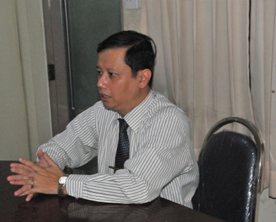
Name: Myo Min Htwe

Job Title: Managing Director

Age: 44

Employer: Win Consulting Ltd

Profession: Financial and Business Consultant

MI: How did you begin your career in Myanmar? How did you arrive at your current position today?

MMh: I graduated in Commerce from the Yangon Institute of Economics back in 1993. Then, I pursued Certified Public Accountant (CPA) Course (two years) and at the same time served as Article Apprentice at Auditor General Office from 1994 to 1996. After passing the CPA examination and completing the training, I joined Win Thin and Associates (WTA) as a senior auditor. In 1997, when WTA set up a joint venture company, namely SGV-WIN THIN Consulting Ltd with SGV International of Hong Kong (itself an affiliate of former audit firm Arthur Andersen and one of the Big “5”). I became a tax senior executive due to my interest in tax matters. The JV company was deactivated in 2000. Just prior to deactivation, Win Consulting Ltd was set up by WTA as a 100% Myanmar Company. I became the Managing Director from then until now. It has been fourteen long and eventful years and a total of eighteen years including working for WTA & SGV-WIN THIN Consulting Ltd.

MI: What is a typical consulting assignment like?

MMh: It is typically very much start-up business focused, with advice on Foreign Investment Law (FIL), Myanmar Companies Act (MCA), local Tax Laws and Regulations, Labour Laws, etc.

MI: How do the clients normally know about your firm?

MMh: U Win Thin, our Chairman, has been practicing as a Certified Public Accountant since 1958. So, the continuity of service and brand are there. That’s how the local clients were drawn to us. We have many tie ups with international firm setups such as SGV (one of the member firms of Arthur Andersen) in 1997 to PWC (Price Waterhouse Coopers, Singapore) in 2012, drawing foreign clients into our operation.

Of course, the rest is due to our reputation, service performance and recommendations made by clients.

MI: Do you see any of your firm having to change or adapt to Myanmar’s new trends and its opening up to international markets?

MMh: Nowadays, international consulting companies are establishing branches or their subsidiary companies in Myanmar too. So there is more competition and tougher competition from global firms. We have to upgrade the capacity of our staff quickly through training and keeping abreast of changes in policies and regulations.

We also realize that there are more opportunities for qualified staff and we are also hiring more staff to take advantage of the opportunities.

MI: How do you feel that foreign companies now entering into business here will affect the local workforce, and do you feel that they will bring new opportunities to existing local businesses?

MMh: In general there will be better employment opportunities for the local workforce. More factories are being set up under the new FDI (Foreign Direct Investment) Law in place. It is now a lot easier for locals to find jobs. From the business perspective, foreign companies are tying up with local companies and the local companies can now obtain funding and technology transfer better than last time. They now have a chance to be more successful.

MI: Could you briefly explain the differences of Myanmar company law versus our neighboring ASEAN countries? How do these laws affect foreign investors?

MMh: Our MCA came from British Common Law in 1914. So it is quite similar to our former British colony neighbors e.g. Malaysia, India, etc. There are some unique things about our MCA:

  1. For certain countries, they need to have a local citizen or resident, to form a company in the respective countries. In MCA, there are no such requirements. Foreigners can form a company by themselves in Myanmar.
  2. According to MCA, there shall be at least two directors in the Board. Many other countries permit a sole director.
  3. There is no requirement to appoint a company secretary in Myanmar. It is not compulsory.
  4. The Company cannot buy its own shares.


MI: If you were, hypothetically, entering into business for the first time in Myanmar, what are the key factors of consideration; and what would be the typical issues that you would like to address before investing?

MMh: I would expect the foreign entity to do market research for the business to be carried out in Myanmar or a feasibility study if they would like to make FDI. Knowledge of rules and regulations governing company law, taxation, banking facilities, FIL, labour law, dividend payment, etc. For manufacturing entities, they should enquire about land lease and prices first.

MI: From a business standpoint, what do you feel are the biggest challenges facing your firm in the next 1-3 years? As the largest consultancy firm in Myanmar, what are the steps your company is doing to address these issues?

MMh: The first challenge would be staff turnover. I am sure it is not solely faced by us. There is a major issue facing all companies here to recruit and retain qualified people. The second challenge is also staff related: finding qualified and knowledgeable people to deal with foreign investors to advise them on legal issues. Normally, we practice a bit of over employment to address the first issue. We also train our people very regularly and we try to retain them with not just financial benefits, but also other incentives.

MI: How do you see Myanmar comparing with its Asian neighbors in the short and long term future?

MMh: Technical skills and know how are needed before we even try to compete. It also depends on our speed of economic development, which in turn depends on FDI. The government has been attracting foreign investors by putting in place FDI laws, SEZ (Special Economic Zone) laws, etc. The more FDI we get, the faster will be the economic growth and the faster we can catch up. E.g., Government issued telecom licenses to foreign entities and within a couple of years; we can expect to be on par with neighboring countries.

MI: If you could make one major change in the country to make it more competitive, what would it be?

MMh: We need to build more industrial zones/parks. Foreign investors want to invest, but they are turned off by high land prices. I therefore believe more industrial zones/parks and reasonable land rent will help. The government is implementing Special Economic Zones like Thilawa, etc., but more are needed.

MI: What would be your advice to the future Accountants/CPA on their roles to modern business world that Myanmar is gradually exposed to?

MMh: I am in advisory role, so I would ask them to work towards that role. Learn and update themselves on laws and regulations changes. I would also encourage them to try harder to compete and be able to give sound advice to investors.


Inaugural australian trade Delegation to Myanmar

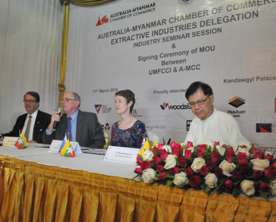
The Australia-Myanmar Chamber of Commerce Limited hosted one of Australia’s largest business delegations to Myanmar in March. Co-hosted by the Australian Trade Commission, the Australian delegation brought together 20 Australian companies with a combined market capitalisation of over $110 billion, with a strong interest in Myanmar and focus on the Extractive Industries.

In welcoming the delegation to Myanmar, the leader of the delegation, The Hon. Warwick Smith AM, Senior Managing Director (International and Institutional Banking) at ANZ Bank and Chairman of the Advisory Panel of the Chamber said that:

Australia is a world leader in the extractive industries and the strength of this delegation is a testament to the potential Australian companies see in Myanmar. Australia has the capacity to play a critical role in Myanmar’s path towards economic renewal. We have much to offer the country in terms of skill and knowledge transfer in the extractive industries. This delegation will facilitate deep engagement with both industry and Government and promote the growth strong and prosperous business networks.

The delegation culminated in the signing of a Memorandum of Understanding for cooperation and assistance between Republic of Union of Myanmar Federation of Chambers of Commerce and Industry (UMFCCI) and the Chamber. The signing was witnessed by Her Excellency Bronte Moules, Australian Ambassador to Myanmar. Commenting at the signing ceremony attended by over 120 local Myanmar companies, the Chairman of the Chamber, Mr Glen Robinson said:

Both Australia and Myanmar have much to gain from closer business ties and the opportunities presented by Myanmar’s transition to an open economy. The signing of the MOU between the Chamber and UMFCCI is a historic milestone and provides a platform for closer business engagement in the years to come.

The Australian Delegation met with over 150 Myanmar industry representatives to exchange views on the opportunities and challenges for investments in the extractive industries.

Myanmar Government Meetings

The Delegation also held discussions with a number of key government Ministries (including the Ministry of Finance, Ministry of Mines and Ministry of Energy) as well as Parliamentary Committees, to develop a deep understanding of the investment conditions in Myanmar and to share Australian best practices in mining and energy sectors. The delegation also met with the Economic Committee of the National League for Democracy.

The Chamber and its Australian members are dedicated to further strengthening the relationship between Australia and Myanmar by promoting responsible bilateral trade and investment between the countries.

La Min Win, a representative of the Chamber’s management committee stated:

I am very proud to be associated with the largest delegation of Australian companies to Myanmar. This is the beginning of a long relationship between Myanmar and Australia and I am excited to see ongoing investment from responsible Australian companies.

he Australian Extractive Industries Delegation ran from 16 – 20 March 2014 and was an initiative of the Australia-Myanmar Chamber of Commerce.


a Positive Experience – an Interview with the German ambassador to Myanmar

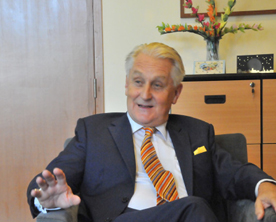
Name: Christian-Ludwig Weber-Lortsch

Country: Germany

Job Title: Ambassador

Profession: Lawyer

MI: What is your mission in Myanmar?

CLwL: My main purpose is to reinforce the relationship between Germany and Myanmar in many areas. We are also trying to assist the Myanmar government to rebuild the country, through sharing our experience in the process of the unification of Germany. With the recent visit of his Excellency, the President of Germany, we want to bring back our historic ties in business, culture, education and development cooperation.

MI: How would you describe the relationship between Germany and Myanmar over the years?

CLwL: We celebrate 60 years of official diplomatic relations. Of course, there were ups and downs during these times. After Myanmar’s independence, Germany had a strong presence here. It was the biggest developing partner, after Japan. In the late 80s, due to the political situation in the country, our activities were somewhat reduced. Now we are back!

MI: Tell us one thing that surprised you when you first started your assignment in Myanmar.

CLwL: When I made my first visit, it was like a journey back in time: Poor phone and internet lines, no mobile roaming, daily power cuts, no ATMs, rattling old taxis without air con and wet seats during monsoon season! Many of these issues have been fixed. Luckily the old charm of Myanmar is still being kept. Friendly people who donate to monks every morning, it is still a very special place. Myanmar is more modern now, yet still keeping its old traditions. A good example would be the preservation of historic buildings. A team of research experts led by a German professor have just published the first Yangon Heritage map.

MI: Why would you encourage German companies to do business in or with Myanmar? What are the focus sectors/ industries that you would encourage German companies to invest in?

CLwL: First, we have to understand the definition of doing business; German companies can buy, sell or invest. All three have potential.

There is potential to buy textiles, agricultural products, seafood, etc. What Myanmar needs is assistance to meet EU-standards to facilitate the import of these goods.

Germany sells high class technology products. Myanmar is famous for its natural resources. German companies can play a role here by supplying equipment and tools to upgrade the technology of extracting and processing these raw materials.

Investment wise, German companies manufacture in Myanmar to sell locally, in the region or to re-export back to EU. There are many hidden champions in Germany: High tech SMEs that produce components for machinery, automotive, pharmaceutical, chemical industries and consumer goods. They can all play a part in business here.

MI: How many German companies have invested in Myanmar so far?

CLwL: There are more than 30 companies in various forms of investment engagements; such as textiles, ship management and training, detergent factory to name a few. Most are in partnership with locals and a pharmaceutical factory will begin production next year. German companies apply international technical and social standards.

MI: Germany as one of the world largest car producers in the world; we see many Mercedes Benz and BMWs while strolling in Yangon. How do you see the auto market development in Myanmar?

CLwL: I am proud that German high-end brands are here. I would love to see also more mid- market vehicles. For the development of an auto market, every country has to follow its own path. It is not easy to come into the auto manufacturer league. I think it is premature to assess Myanmar’s potential for building its own automotive industry. Currently the car market is mainly a pre-owned market. Of course, the number of cars on the road has gone up significantly. When I arrived two years ago, I used to go back home daily for lunch. Due to traffic this is no longer possible.

MI: Machinery – Germany is well known for its machines and engineering. As lots of infrastructure projects are coming up coupled with the government’s commitment to industrialization; how do you see German companies playing their part in these areas?

CLwL: Machinery is our biggest export line to Myanmar. We can play a significant role in this nation’s country technology upgrade. For building-up industries you need machines. With engineering, planning and high tech components, German companies contribute to modernizing and rebuilding the infrastructure.

MI: What about soft skill training in the relevant areas?

CLwL: There are two aspects to this. The first one is government to government training and development assistance. We fund a Vocational Training Institute that provides industrial training, under the auspices of Ministry of Industry. It is located near the city of Pyi. The second aspect is the in house training programs of our companies. In Germany we have a two-track vocational training system, which combines theoretical classroom teaching with practical in-company instruction.

MI: Are you satisfied with the current reform process? Which areas have exceeded your expectations and which areas have not?

CLwL: The Myanmar Government has initiated a comprehensive reform and modernization process. Today there are more than 60 political parties, 600 plus labor unions, censorship has been abolished. I admire and congratulate the Reform-Government for what has been achieved in such a short period of time. Now comes the heavy lifting part, such as constitutional reforms, the peace process, a possible move towards federalism and fair and transparent elections next year. The basic rule of democracy is peaceful transition of power, which will lead to confidence in the political system by international investors.

The country needs both, economic growth and a fair distribution of wealth and a reform of the educational system.

MI: Germany is the 2nd largest donor to Myanmar after Japan, I believe, what are the priorities of Germany government to assist the growth of this country?

CLwL: Our development cooperation concentrates on sustainable economic development. It is sub-divided into three different programs: vocational training, private sector development and financial advice.

For vocational training, we fund the institute as mentioned before and we also provide experts for the institute.

For private sector development, we provide general advice for example for the new SME (Small and Medium Enterprises) law. We also send experts to Taung Gyi, for practical development of SMEs to improve Agricultural products supply chain.

SMEs are the backbone of the German economy and they are the engine of job creation in Germany. Another element of our program is to improve access for SMEs to finance.

The assistance is provided by GIZ (German International Development Agency) and KfW Development bank.

MI: What are the main policies your Excellency expects to see in the near future to enhance Myanmar competitiveness in the region?

CLwL: Some business people complain about the infrastructure, legal system and bureaucracy. In Myanmar, one cannot run a factory or even an office without a generator set. And running a generator set increases costs for the industry. One cannot be competitive with that. In terms of bureaucracy there are still leftovers of the old days in the government machinery. For example, foreigners are not allowed to legally register a local mobile phone number here. Many regulations discriminate against foreigners and business. Investors need clear and transparent rules and regulations.

MI: From a country development standpoint, what do you see are the biggest challenges facing the current government in the next 1-3 years?

CLwL: The first challenge would be infrastructure. The Government is doing a lot, but decades of neglect cannot be fixed in a couple of years. The next one would be to further integrate the ethnic minorities. Peace is not everything, but without peace, everything is nothing. Armed conflicts block development and poverty alleviation. Myanmar is a rich country with a poor population.

MI: Some investors are adopting a wait and see attitude; investors are looking for long term stability after 2015. What are your Excellency’s thoughts on political stability of Myanmar after 2015?

CLwL: Investors should start to look for opportunities right now. Every business is different. In terms of political stability, I don’t advise companies to wait for the next elections.

My thoughts and wishes for the Myanmar future would be one of national reconciliation in politics and on the ground. The world is watching you: a successful reform process in Myanmar would set an important example for a peaceful change towards democracy and prosperity in the region and beyond.

MI: How do you see Myanmar comparing with its Asian neighbors in the short and long term future?

CLwL: If we go back in time to the late 1950s, Myanmar was one of the most developed countries in Asia, richer than Thailand, Korea or Singapore. Today, the map has changed. Some went up, others down. Success was mainly home-made. Hard work and education seem to be more important than natural resources. And history teaches us that isolation is a certain way to loose competitiveness and development.

Myanmar has all the potential to catch up with its more developed neighbors. But it will take time and full commitment of each and everybody. In the end, productivity is more important than the “unearned” income of fantastic property prices.

MI: What advice would you give a German company to consider before putting their money in Myanmar?

CLwL: Do not start with money. Doing business is not a donation. Test the market; look for a good partner with proven record of business and trust. Then, use your calculator!




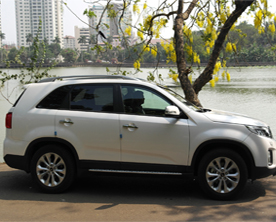
The 2014 KIA Sorento – Best value Suv

The KIA Sorento is a large SUV that has standout features like a spacious interior, seven-seat layout and large boot when the third row seats are folded down. As an All-Wheel Drive (AWD), it will ensure good road holding more so on Myanmar roads and even in the worst weather conditions. On top of it all, it has a reasonable price tag and a powerful diesel engine that offers strong fuel economy. And with KIA’s excellent five-year warranty it will stay ahead of its competitors in Myanmar.

Despite looking very similar to the second-generation vehicle it replaces, the 2014 KIA Sorento is a new generation vehicle that offers an 80% change over the outgoing Sorento. The third-generation 2014 model brings changes that help make for an even better-looking crossover. Improvements include LED daytime running lights and vertical foglights up front, while horizontally oriented LED taillights add a much cleaner look to the Sorento’s back than the outgoing model’s square-shaped, honeycomb units. Overall, these modest improvements have given the 2014 Sorento a more mature and classy appearance.

Interior wise, the Sorento’s cabin has a redesigned center console with a larger touch screen infotainment display and a T-handle gear shifter that oozes luxury. That attention to detail is also evident in all the new switches and knobs. The rear seats now have an additional 1.2” of legroom to go with the sliding and reclining 40/20/40 second-row seats. The third row seat is still intended for smaller occupants. Another interesting detail of the Sorento’s back seat is the ISOFIX latch that allows anchoring of child seats.

Practically is the Sorento’s main strength. Boot space is pretty limited with all the seats up, with just 116 liters of capacity but the third row of seats can be folded down easily with the pull or a chord to free up a humungous 515 liters of trunk space. And with the second row down you’ll have an enormous 1,530 litres of capacity. The loading area is pretty flexible too, as the third row split-folds 50:50 and the second row folds 60:40.

There’s only one engine available on the Sorento, an excellent 194bhp 2.2 – litre diesel power plant coupled to an equally excellent six-speed automatic transmission. It provides plenty of power and toque, and will accelerate the car from 0-62 mph in under 10 seconds with a top speed of 118 mph. That makes it very quick for a car of this size. The Sorento also feels surprisingly nipppy on the road and is equally agile on twisty roads. The all-wheel drive (AWD), which is fulltime four-wheel-drive provides a comfortable ride with decent power, comfort and composure for that long distance ride.

The Sorento scored the full five marks in the Euro NCAP crash safety tests. All models come with an array of safety kit including six airbags, electronic stability control, anti-lock brakes and traction control. It is also equipped with hill-start assist (HAS) and electronic brake force distribution (EBD) to improve braking control.

At just above the 500 lakhs mark [K50,000,000], the Sorento offers great value for money with a panoramic sunroof, full options and even a reverse parking camera. KIA’s rivals would be foolish to take the threat it poses with anything less than total seriousness.

In conclusion, the new KIA Sorento provides a lot of evidence that KIA has come a long way and the Koreans have become a motor industry force to be reckoned with. Not only is the SUV a likable and capable car but it also offers a comparison to someone looking for a SUV close to the top of the class. It’s hard to fault its build quality.

In all, this new Sorento appears to have what it takes to compete with the best European SUVs. Make no mistake, this is great car, well priced and great value for money. And if that is not convincing enough, the numbers of Sorentos on yangon roads might just convince you the car is indeed popular.


Ngapali Beach

The plane to Ngapali Beach pretty much lands on the beach itself, so maybe think twice about going if you’re a nervous flyer. From the cabin window it looked as though we were about to land on water, then a short, dusty runway appeared from nowhere just before we hit it. Baggage claim took place in the carpark outside the tiny airport’s main entrance.

Greeting tourists as they arrive at the outdoors baggage reclaim is a giant red billboard with the following written in Burmese and English: “Drug trafficking is a serious crime and punishable by the death penalty.” So maybe think twice about going if you’re a drug trafficker.

Ngapali is booming – sort of. The road that runs parallel to the beach is being widened from a dusty track into a two lane highway as Myanmar opens up to the world and more and more tourists make the short flight from Yangon.

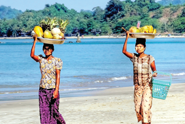
But, the place still feels like a lazy island paradise; there is a smattering of beachside hotels and plenty of room for everyone on the vast white strand, where Rakhine women selling pineapples and mangoes from baskets balanced on their heads stroll leisurely by.

The hotel I stayed in, the Lin Thar Oo, is a cluster of huts and outhouses built from dark, solid wood and close enough to the sea for the sound of waves breaking against rocks to permeate everything. The large restaurant deck out front gives a stunning view of a fat, orange sun extinguishing itself in the ocean at dusk.

I ordered a cocktail for about US$3 and watched a father and son on the beach tending their horses, which I assume you can pay to ride but I didn’t ask – terrifying creatures. I can report, however, that the heavenly soft white sand of Ngapali is, by some miracle, free of horse manure.

After sunset, I chain smoked some cheap Burmese cigarettes on my spacious private balcony and went to bed, for tomorrow there would be snorkelling. At 7am, I was dressed in my red swim shorts and so eager to enjoy the breakfast buffet that I didn’t apply sun block; the worst mistake I, a pasty white man, have made in a while. I had mohingya soup with a generous helping of not too appalling coffee and a fried egg placed lovingly on top of some noodles. Even though the sea was right there, I hadtotakearideonthebackofamopedtoget to the boat that would take me snorkelling. My driver shouted back intriguing titbits about the village we were passing through; he had a deep, gravelly voice acquired, I assume, by constantly breathing in the dust that billowed generously up from the road. I was the only tourist on the boat, but if I’d have had friends it would have accommodated five of them. The driver steered the propeller with his foot while his son sat in wistful silence as we floated out to sea.

We dropped anchor near a cluster of rocks just off a small island. The snorkelling wasn’t great; the water was murky and it was difficult to make out the small, brightly coloured fish circling below.

The scenery made up for it, though. We came around a large land mass and into a bay throbbing with local fishing boats. On the peak of a hill that jutted out into the sea was a giant statue of the Buddha draped in gold. I got the driver to drop me on the beach so I could trek up for a closer look. From the baking concrete platform at the base of the statue is the best view you can get in Ngapali Beach: to the right, the beach bends around the sea in a slender white crescent, half encircling the large cluster of boats in the bay; to the left, the glistening blue Bay of Bengal stretches off over the horizon and onwards to India. On the way down we passed a monk coming the other way, dressed in pristine orange robes and a pair of aviator sunglasses.

Ngapali is around 50 minutes by plane from Yangon, so it’s ideal for a quick getaway if the choking traffic and crumbling pavements of the former capital get to be too much. Bear in mind that flights to and from Thandwe Airport tend to go once a day in the early afternoon, so you need to stay at least two nights if you want to enjoy a whole day there.

Make sure to visit one of the beach shacks run by locals, where your waiter will hack the top off a coconut with a machete and serve it to you with a straw.


Latest Videos

Interview with Alison Fox Principal of The British School Yangon

Interview with Alison Fox Principal of The British School Yangon

Recent Posts