Home Blog Page 234

Remaining the number one lift brand in Myanmar: Willis Phua interviewed

Name: Willis Phua

Nationality: Singaporean

Company: Jardine Schindler Lift Co Ltd

Position: General Manager (Myanmar)

Profession: Engineer

Brief Background Summary:

Willis received his executive education at Harvard University and has worked for Schindler for nine years. He served in differ-ent roles in Singapore and Vietnam before coming to Myanmar.

[paypal]

MI: When was the first time you visit-ed Myanmar?

I first visited Myanmar in 2012 with the Remaining the number one lift brand in Myanmar: Willis Phua interviewed by Charlie Greene management team of Schindler Singapore to discuss details of Schindler Myanmar’s business expansion. As the Director of In-stallations at Schindler Singapore, I had the opportunity to examine various areas of op-erations, ranging from technical to operation support, to which my Singapore team could contribute.

MI: What was your experience back then?

My first experience was very positive – even inspirational. On my first trip to Myanmar, I saw the obvious commitment and willing-ness to listen among our Burmese colleagues. They made genuine efforts to understand the practices in other countries, and adapt them to their work here.

My impression of the Burmese was that they were very friendly and positive people who were eager to learn. Having the opportunity to learn new skills and develop themselves seemed to drive their work.

One particular incident that touched me deeply was the case of a Schindler Myanmar employee who had been fighting cancer for several months. Days before he passed away, he asked his visiting colleagues to bring him a brand new Schindler uniform to wear during his final rites. He was proud of Schin-dler, a company to which he had dedicated 13 years of his life, and he wished to leave the world decorated in its uniform. I was deeply moved by the spirit of these people who take such great pride in their work.

MI: What are your impressions of the country now? There is great potential for development in all sectors of business in Myanmar. Schin-dler has operated in the country since 1999, and for 15 years of those years, has func-tioned as a 100% foreign-owned entity. We have been present here during good times and bad, reflecting both our commitment to the country and our belief in its future.

We are dedicated to building a strong team in Myanmar and providing employment opportunities for local Burmese people. In-stead of hiring expatriates, we are investing in people and capital to build a strong foun-dation for future expansion. For example, we have sent Burmese staff for overseas train-ing on more than 20 occasions in the past eight months alone. We have also brought in an experienced technical trainer from Sin-gapore to assist in bolstering the technical skills of our technicians.

MI: Is it easier to settle in as far as business is concerned, given that Schindler was established as a ful-ly-owned foreign company 15 years ago?

Schindler has indeed developed strong roots in Myanmar since entering the market 15 years ago. Our passion for quality and pre-cision engineering has driven us to a leading position in the Myanmar lift and escalator market. Customers have come to rely on Schindler to provide excellent customer ser-vice and premium quality.

With a rapidly growing portfolio, my focus is to build up the technical capabilities and capacities of our people, allowing us to deliv-er a consistently high level of service to our growing customer base. I strongly believe in providing what customers really need; that is, the highest quality products, installations and customer service. That is what Schindler is committed to delivering in Myanmar. As we progress towards that goal, we have al-ready grown into a sizable company of more than 100 people, compared to only 30 just a couple of years ago.

MI: How does working in Myanmar under the present business climate compare with other Asian countries?

I do not believe there is a single country in Asia whose economic and political landscapes are as unique as those of Myanmar. Being in Myanmar at this stage in its devel-opment is a once-in-a-lifetime opportunity. The country is a genuine “last frontier”. Few other countries present such robust and ex-citing growth potential.

MI: What are the challenges with the local workforce?

How do you address these? The main workforce challenge lies in the shortage of experienced people. The market has boomed in a short time and demand for the best people is increasing as companies compete for the most skilled employees. Therefore, as well as hiring people from the market, we are also training fresh graduates and developing people internally.

We also offer apprenticeship training schemes, whereby we train first-year ap-prentices to carry out lift installations un-der the supervision of senior technicians. Subsequently, the apprentices lead the final installations with strict requirements to ob-tain high QC (quality control) scores. These trainees are deployed as permanent staff members only if they are able to achieve this high standard. The process helps instill in every new employee the importance that Schindler places on quality.

In addition to fair monetary rewards, I be-lieve that there are three important factors for employee retention: 1) we must provide a sufficiently challenging scope of work; 2) we must create a positive work environment; and 3) we must ensure that managers plan for each employee’s career advancement. In Schindler, we also provide free English lessons, computer classes and various insur-ances as part of our overall approach to staff retention.

MI: What are the benefits of doing business in Myanmar now, compared with 15 years ago?

Myanmar has unique market dynamics and promises strong growth potential. With bright economic prospects and a high num-ber of planned projects in the pipeline, the Myanmar elevator and escalator market will undoubtedly continue to experience impres-sive growth. By upholding our values, we hope that we will continue to capture a sig-nificant portion of this growth market. In addition, the company’s rate of growth is helping Jardine Schindler Myanmar to be-come a more significant contributor within the overall Jardine Schindler Group.

MI: What effect do you think that the sudden influx of foreign companies/ nationals will have on the country and its people/culture?

Myanmar people can now experience a world of opportunities. To benefit from these opportunities, they will need to retain their hunger for learning and develop additional skill sets.

In the short term, both foreign and local cultures will need to learn from each other and adapt accordingly. In the long run, due to their willingness to learn, the Burmese people’s skills and knowledge in areas such as business management, finance, vertical transportation technology and safety aware-ness, will improve.

MI: If anything could be introduced quickly (for example, over the next 6 months) to improve doing business here, what measure(s) would you choose to implement?

Specifically for construction, it would be beneficial to introduce laws governing con-struction safety.

Schindler places high emphasis on the safe-ty of our employees on construction sites. We operate a strict health and safety policy to promote the wellbeing of our employees and to maximize safety in the workplace. For example, we realized that there is a lack of established regulations governing scaffold safety in Myanmar. To solve this, we sent our Burmese safety officer to Singapore for training and certification on scaffold and construction safety, by the Singapore au-thorities. We subsequently introduced and continue to apply the same safety standards here in Myanmar.

MI: Are there any other risks that you see for the economy?

There is a continued need for infrastructure development to accommodate the country’s rapid economic expansion. Other funda-mental issues, such as the creation of suit-able legal and banking systems, are still un-der development.

However, I am convinced that the Govern-ment is open and truly wishes to address these issues as best it can in the interests of its people.

MI: What are the company’s long-term objectives? Our goal is to remain the number one lift brand in Myanmar in terms of customer service. Our company vision is “Leadership through Customer Service,” and we are con-tinuously looking for ways to raise the bar in delivering this vision.

For example, as we assess the growth of the lift and escalator market, we seek to expand beyond our current offices in the main cities of Yangon, Mandalay and Nay Pyi Taw in or-der to better serve our customers. This will help to bring our service closer to the cus-tomers we serve.

MI: What tips would you like to pass on regarding what to consider when choosing a lift?

Schindler has operated as an elevator and es-calator company since 1874, and each of our lifts is designed and manufactured according to very stringent international standards. All of our products undergo strict safety inspec-tion tests to ensure their quality and per-formance prior to being handed over to our customers.

In addition to product quality, it is important to look at whether the company can deliver on its promises. For example, does the com-pany have a strong project and maintenance fulfillment team? Are its service personnel responsive whenever I need them? Or is it just a distributorship that offers low actual accountability when you require its support? Buying a lift is an investment for the next 25 years, and it is critical to work with a compa-ny that is innovative, responsive, and com-mitted to safety.

MI: With the benefit of hindsight, would you have done anything differ-ently when you started, and why?

Part of the attraction of taking up the chal-lenge of working in a fast-growing, dynamic country like Myanmar is the opportunity to “live and breathe” the experiences it has to offer. Therefore, as I build on the strength of our existing operations here, I embrace each opportunity to learn and further improve our performance.

MI: From a business standpoint, what do you feel are the biggest chal-lenges facing you and your organiza-tion in Myanmar in the next 1-3 years?

The shortage of experienced manpower means that the industry as a whole will face challenges, such as building up fulfillment capabilities and technical expertise, to keep up with construction demand. Schindler is doing everything possible today to meet our objective of leading the market through cus-tomer service and quality. For the same reason, our focus is on upgrad-ing our technical fulfillment capability by recruiting high quality people and investing heavily in training.

MI: If you were, hypothetically, en- tering into business for the first time in Myanmar, what are the key factors to consider; and what would be the typical issues that you would like to address before investing?

I think the primary challenge for sustained business success in Myanmar is to consid-er whether your products and services will add value to its economy over time. It is also important to learn about the local business culture.

MI: How do you imagine Myanmar will compare to its Asian neighbors in the short- and long-term future?

In the short term, it will be an exciting mar-ket. As we are already seeing, there are many investment opportunities that are likely to deliver short-term growth. In the longer term, it depends on the devel-opment of Myanmar’s infrastructure. We have seen tremendous growth in countries like Indonesia and Thailand over the past decade, and I believe Myanmar will enjoy the same, if not even more, stellar growth.

MI: If you could make one major change in the country, what would it be?

My priority would be for the government to focus on infrastructure. Having proper in-frastructure in place (roads, telecommunica-tions, the Internet, etc.) will provide a great foundation for businesses.

MI: What advice would you give to someone looking to start up a busi-ness and invest in Myanmar?

Think long term, and be prepared to invest.

MI: How are you enjoying pres-ent-day life here in Myanmar?

What do you like/dislike about your life in the country? I like the people here, and enjoy interacting with our staff and with new friends. Life in Myanmar is simple, and having lived here for more than a year, I have learned to ap-preciate how the simple things in life can bring so much satisfaction and fulfillment.

Some foreign friends lament the lack of cer-tain luxuries that are common in their home countries. However, I find a level of happi-ness amongst the Burmese that we do not often see back home in Singapore.

MI: You have a family back in Singa-pore. How do you manage to cope with being away from family for long peri-ods?

We communicate daily. Also, both my wife and I are fairly used to regular travel. I think that trust builds up over time.

[/paypal]
Southeast Asian Games: End of Term Report

With the theme of “Clean, Green and Friendship”, the 27th Southeast Asian Games (SEA Games), hosted in Myanmar in December, were billed as the country’s ‘coming out party’ as it continues its emergence from decades of self-imposed isolation and aims to attract international investment and visitors to a country that just four years ago was off-limits to all but the most adventurous of travelers. Myanmar last hosted the SEA Games in 1969 in former capital Yangon, when just six nations competed in an event that Vietnam was forced to handover due to the ongoing Vietnam War.

The host nation performed well at the event, topping the medal table comfortably, almost doubling the Gold medal count of second-placed Thailand.

Things have changed somewhat since then, with Myanmar finishing outside the top half of the medal table for the majority of events since last hosting it.

The host city was different too. The ruling government used the opportunity of hosting the Games to help promote the strange city of Nay Pyi Taw, located 200 miles north of Yangon.

Nay Pyi Taw, carved into the middle of the jungle, was established as a city in 2006, taking the title as the most recent incarnation of the country’s long list of capital cities and has generally been met with ire by those who have had the luxury of visiting. With large empty roads and buildings and vacant streetlife, many observers wondered, and continue to wonder, if the city has much of a function beyond a vanity project for the previous rulers (it must be said, the gardens are wonderfully kept). But the government is determined, and is adamant that it can turn the sparsely populated city into a thriving tourist destination.

While there is a long way to go, some progress is being made. Many of the animals from Yangon Zoo have been relocated in the new capital, while parks and museums have been established, as well as the magnificent

Uppatasanti Pagoda, which rivals the revered Shwedagon Pagoda for height.

The SEA Games were the most recent opportunity to help build the city’s reputation. Most notably, the government built an international-quality sports complex specifically for the Games, the likes of which have never been seen within the country before. The Thunna Weikdi Sports Complex houses, amongst other things, a boxing stadium, equestrian center, aquatic center as well as the event’s centerpiece, a 30,000-seat stadium which hosted the largest events of the Games, the Men’s Football final as well as the opening and closing ceremonies.

In most quarters, both the opening and closing ceremonies were lauded as successes with impressive and extravagant firework shows having been put on display, largely due to heavy involvement from China, who allegedly lent $33 million in financial support to the Games, as well as providing stage designers, technicians and a host of experts. Myanmar’s social media circles went crazy with patriotic pride at what the country had achieved, but criticism was not avoided altogether. U Min Thu, an MP for opposition party National League for Democracy, criticised the event for its “Beijing-cited ceremony”, referring to the extravagant opening for the Beijing Olympic Games in 2008.


Mandalay’s Ko-Thwe Rubies

It seems that nothing unpleasant can be heard about Myanmar nowadays. Formerly known as Burma, this exotic Southeast Asian country was once a jewel in the British Empire – a fascinatingly exotic land that was the world’s largest exporter of rice, a global supplier of oil, a nation rich with natural and labour resources, producing 75 percent of the world’s teak, and the wealthiest realm in this corner of the earth. Today, it is being called “Asia’s last frontier”.

One rare, shining glow the colour of ko-thwe (pigeon’s blood) is Myanmar’s ruby industry. Supplying 90 percent of world demand, rubies prized for their purity and hue comprise the biggest earner in the country’s total sales of precious stones, which include sapphires, pearls and jades. One of the country’s most viable industries that also includes agricultural goods, textiles, wood products, construction materials, metals, oil and natural gas, the trade in precious stones continues to flourish. In fact, several years ago, during the annual gem show traditionally held in Yangon, a total of 2,380 gem merchants, including 1,484 of 423 companies from 16 countries and regions, coughed up US$101 million in gem purchases, which at the time broke the record held since the show was introduced almost 50 years ago. It was the conduct of these gem shows, officially dubbed the “Myanmar Gem Trade and Pearl Emporium”, which has earned for Myanmar international renown as “Ruby Land”.

Needless to say, Myanmar’s previous military rulers depended on sales of precious stones to fund their regime; they had to release their stranglehold on the industry to ensure a continuous inflow of funds. In the early 1980s, the government started taking great strides towards enhancing gem and jewellery sales by opening up its activities through purchases of gems and jewellery from private dealers or owners at acceptable prices. Then, it encouraged privatisation by allowing private owners to exhibit their gems for sale at the annual emporiums, and those who attained substantial sales success were permitted to open foreign currency accounts with the banks. Also, it started quality inspections of private shops and allowed those who passed to sell their items in foreign currencies. Finally, gem trading centres were licensed to openly sell jewellery with 15 percent tax paid to the government. Private trading and export of gems has thus become simple and legal for the first time in over 30 years. To drive the gem mining industry towards greater growth, Myanmar enacted the “New Gemstone Law” in 1995, which allowed local entrepreneurs to mine, produce, transport and sell finished gemstone and manufactured jewellery at home and abroad. Since 2000, the government has undertaken joint ventures with ten private companies in the mining of gems and jade on a profit sharing basis.

Myanmar has three famous gem lands well known for producing the country’s nine gems – ruby, diamond, cat’s eye, emerald, topaz, pearl, sapphire, coral and a variety of garnet tinged with yellow. One is at Mongshu in Shan State and another at Phakant in Kachin State. But, the temple of the very rare ko-thwe rubies is at Mogok, a most scenic area consisting of heavily petrified hills rising to a height of 2,347 metres above sea level. Mogok is within the district hosting the nation’s second largest city – Mandalay – Upper Myanmar’s economic hub and the centre of Burmese culture, the fabled city that inspired classic poetry by Rudyard Kipling, books and essays by George Orwell and songs by Frank Sinatra, the Beatles’ George Harrison, Robbie Williams and the Eagles, to name a few. Just as Mandalay is legendary, so is Mogok’s ko-thwe ruby.

Gemological circles all around the world choose Myanmar as the one exotic country with the world’s choicest coloured gemstones, “Burmese” rubies are the standard by which any ruby is judged, as the case is with top quality sapphires, spinels, peridots and jadeite jades. Mogok rubies are readily regarded as being in a class of their own. As one gemologist described it, “The best Mogok stones actually glow red and appear as though Mother Nature brushed a broad swath of fluorescent red paint across the face of the stone. This is the carbuncle of the ancients, a term derived from the glowing embers of a fire… The colour most coveted today is that akin to a red traffic signal or stoplight. It is a glowing red colour, due to the strong red fluorescence of Burmese rubies, and is unequalled elsewhere in the world of gemstones… It must be stressed that the true pigeon’s blood red is extremely rare, more a colour of the mind than the material world. One Burmese trader expressed it best when he said: “Asking to see the pigeon’s blood is like asking to see the face of God.”

Old Problems

Be that as it may, Mogok’s ko-thwe rubies, alongside Myanmar’s prized coloured gemstones, had faced the threat of trade disruption from international powers. The US had branded Myanmar an “outpost of tyranny”, lambasted the ruling military junta for its “extremely poor human rights record”, and accused the military of murder, rape and other torture. Three of its presidents shunned Myanmar’s dictatorship, and then President Bush signed a law in 2003 banning the import of Myanmar products. On the other hand, some gem dealer members of the International Coloured Gemstone Association criticised the US sanctions as “depriving Myanmar’s citizens of economic growth needed to fuel an eventual democracy”, called the policy “duplicitous because it punishes Myanmar while the US runs trade deficits with more repressive regimes, such as China’s.” Meanwhile, neighbours in the Association of Southeast Asian Nations have advised Myanmar it risks putting the group’s cohesion on the line if political reforms aren’t made. Bulgari,

Tiffany and Cartier are among US and European jewellery companies that refused to import Myanmar gems based on reports of deplorable working conditions in the mines, while Human Rights Watch supported a complete ban on the purchase of Burmese gems based on these reports and because nearly all of the profits went to the ruling junta.

There is hope, though, at the end of long, dark Myanmar tunnel. Myanmar leaders showed willingness to open diplomatic talks with the US to resolve the issues brought up by Americans, especially in regard to political prisoners and human rights. It will be such a waste to stop the treasures of Myanmar drawing to them the businessmen of modern times, as it did the merchants of Venice centuries ago. To let this gem of an industry reach full potential will require the further opening up of the economy, a vital factor in the development of Myanmar in the years to come. Then, the world can truly cherish the magical experience of once more treading the open road to enchanting Mandalay.

The Changing Face of Energy in the Asia Pacific Region

T he oil and energy company, Puma Energy has recently commissioned ‘The Changing Face of Asia Pacific’, this report centres on the prospects for the Asia Pacific region, home to 50% of the world’s population, and for several decades the most dynamic region of the global economy. It focuses on the region’s sources of future growth, its potential, and the various challenges it faces, including meeting substantive infrastructure and energy supply needs. It maps out investment and broader business opportunities for global energy companies such as Puma Energy.

Over recent decades the world economy has been transformed by the globalisation of international trade and finance, the IT rev-olution, the evolution of a transcontinental oil market, and a shifting balance of eco-nomic and political power from the West to the East. The Asia Pacific region has been at the very core of these seismic developments and become the global economy’s primary locomotive. It has offered up the remark-able rise of the Asian Tigers, the emergence of both China and India as global powers, and the advent of an increasingly intricate and dynamic web of trade linkages stretch-ing across the region. Asia’s average annual growth rate over the past 10 years has con-sistently exceeded the global average.

Underpinned by timely and aggressive policy stimulus, Asia Pacific’s post-crisis re-covery has been rapid by the standards of the more mature OECD economies. The region’s GDP is already some 40% bigger than on the eve of the downturn, and domestic demand rather than exports has been instrumental in driving the expansion. China’s prominence in the region and the global economy in gen-eral tends to capture most of the headlines, but there is much more to the Asian story than this. The vibrant recovery has extend-ed right across the region; recent years have seen South East Asia outperforming the es-pecially trade-dependent newly-industrialis-ing economies, while resource-rich Australia has enjoyed a mining boom that is now in-creasingly bearing fruit in terms of its trade performance. In essence, Asia Pacific has left the West behind since the Global Financial Crisis.

The Asia Pacific region produces around 30% of world GDP and accounts for around 40% of global energy demand. Over the com-ing 20 years the region’s demand for ener-gy stands to increase dramatically, by some 50%, and oil by 40%. In the less developed economies of Asia Pacific, the requirements will be greater still: oil demand is expected to double and oil imports to treble. OECD ener-gy demand, by contrast, is projected scarcely to increase, and the demand for oil to fall, by around 20%.

Notwithstanding the region’s impressive performance and its being the envy of much of the world, there have latterly been signs of slowing underlying growth potential and the region faces significant challenges if its potential is to be fulfilled.

A number of economies are at risk of falling into the so-called ‘Middle-Income Trap’, while others risk becoming over-re-liant on credit to drive growth. Efforts both to nurture the right balance of aggregate demand and to encourage appropriate sup-ply-side reforms are vital. This process will prove complex, demanding, multi-faceted and open-ended.

Successful reform means getting a lot of things right. Priorities are developing the region’s institutions, putting in place appro-priate incentive structures, investing heavily in infrastructure and technology, improving the quality of public spending, further devel-oping trade linkages, and encouraging the development of the region’s financial system.

In the case of Puma Energy, “recent ac-quisitions in Australia, Indonesia and Viet-nam, have given us a strong foothold in some of the fastest-growing markets, where our proven ability to support infrastructure and industry growth give us a competitive edge,” said Robert Jones, Chief Operating Officer, Asia Pacific and Middle East, Puma Energy.

The report was the third study in a series of reports in collaboration with independent economic consultants Llewellyn Consulting.

Supplier Adv

Regulatory Update and Market Developments in the Mobile Telecommunications Sector

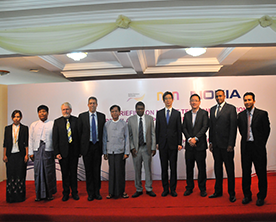
On 19th May, 2014, Nokia Siemens Networks (NSN) partnering with the Posts and Telecommunications

Department of Myanmar (PTD) presented an update on the regulatory reform prog- ress of the telecommunication sector in the region.

The event conducted at the Royal Ku- mudra Hotel, Nay Pyi Taw was launched by U Khin Maung Thet, Director General of PTD. The event provided the Regulators sce- nario of fostering market developments in the region and imparting future technology outlooks within the Regulation. Myanmar’s target is to set up its own Independent Regu- latory body by the end of 2015.

PTD is in the process of finalizing the Multi Services Licensing Framework. The framework aims to simplify licensing pro- cesses; encourage entry and expansion of services; and increase End User access to telecommunication networks and services. PTD will announce details of the licensing framework, spectrum rules and other gen- eral conditions on license application in the near future.

During the event, NSN shared knowl- edge about recent developments and issues in the telecommunication sector, such as fiber optic networks-FOC, microwave sys- tem in the absence of fiber optic networks, GSM/3G, LTE, Value Added Services, and NSN’s Korean experience which could be a classic reference example when considering the telecommunication sector development in Myanmar.

Myanmar is in the process of preparing to launch its own telecommunication sector. The four operators who have been granted licenses are: MPT (Ministry of Posts and Telegraphs); Yadanarpon Tele- port of Myanmar; Telenor from Norway and Ooredoo from Qatar. The government aims to achieve a target of 75% – 80% penetration by 2015.

Ooredoo recently selected NSN to supply its core and radio infrastructure for its 3G network in Myanmar. This historical agreement marked NSN’s entry into Myan- mar’s telecommunications landscape. NSN also aim at working with other clients as well as government bodies to support the devel- opment of the telecommunication sector in Myanmar. Presently NSN focuses primarily on Network businesses in Myanmar.

Mr. Raman Kavundar Vattumalai, the country manager of NSN revealed that presently the company hires about 150 employ- ees in Myanmar. Staff numbers are expected to increase to about 300 by end of 2014. The NSN vision for the country includes:

  1. To help its clients achieve the government target on a penetration rate of 75- 80% by 2015
  2. Priorities on “localization”. With two of- fices located at Centerpoint Tower and MICT Park, NSN will work with local universities and conduct in-house and on-the-job training for its staff and subcontractors.
  3. To conduct businesses to the highest standards of ethical conduct
  4. To achieve 1GB Mobile Data delivery daily by 2020.

As a socially responsible organiza- tion, NSN is planning to implement a CSR (Corporate Social Responsibility) project in

the area of education by end of the year. The initiative will benefit youth and educating young people.

Nokia Solutions and Networks is the world’s specialist in mobile broadband. From the first ever call on GSM, to the first call on LTE, NSN operate at the forefront of each generation of mobile technology. NSN’s global experts invest in new capabilities for its customers needs and their networks. They provide the world’s most efficient mo- bile networks, the intelligence to maximize the value of those networks, and the services to make it all work seamlessly.

With headquarters in Espoo, Finland, NSN operate in over 120 countries and have net sales of approximately 11.3 billion euros in 2013. NSN is wholly owned by Nokia Cor- poration.

STRENGTHENING MYANMAR’S MICROFINANCE INSTITUTIONS

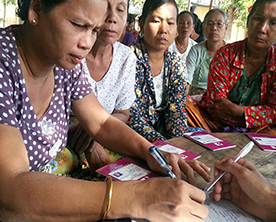
The microfinance industry in Myan- mar was given a boost with the re- cent Responsible Finance Seminar: Laying the Foundations. Held on May 7-8 at the Summit Parkview Hotel in Yangon, the seminar covered issues and challenges faced by microfinance service providers. It was attended by almost a hundred participants from government agencies, microfinance institutions, technical service providers and international donor agencies operating in Myanmar.

The main session focused on risks en- countered by the industry not only in Myan- mar but globally as well. Among the risks discussed was, over-indebtedness – a risk faced by clients; and those faced by micro- finance institutions like credit risk, liquidi- ty, etc.; and the market environment which included competition and political interfer- ence.

The story of the Andhra Pradesh re- gion in India was presented as a case study. In this case the local government of inter- vened by closing a big microfinance institu- tion because of reports of suicides by clients who were over-indebted and subsequently this was reported in the newspapers. The action however resulted in the closure of the lending facility servicing low income groups and the loss of billions of dollars of uncol- lected loans. Although the institutions ini- tiated corrective measures, the struggle to gain back trust of the industry became a long uphill battle.

In Myanmar where microfinance is an emerging industry, ensuring that these risks will not be encountered is a concern. The financial sector of the country is presently dominated by banks and informal money lenders serving as the alternative for those who cannot access banks. Other sources of loan funds include pawnshops, cooperatives and agricultural input producers. In this context the development of microfinance institutions in Myanmar becomes relevant. Providing loans specifically to low-income groups through innovative methodologies like group lending and collateral substi- tutes allows a greater number of low-income people access to loans which can stimulate economic activity and increase household incomes.

With the passage of the microfinance law in 2012; almost 200 microfinance in- stitutions were immediately licensed. Some observers expressed that low entry require- ments and the fast licensing of the institu- tions may lead to abuse, like when savings are mobilized and not managed well. Also, policies like limitations on the individual loan amount and the interest rate cap might push institutions not to be transparent about their operations.

Succeeding sessions were centered on ensuring that microfinance institutions will not only be concerned with financial gains but remain consistent with its mission to alleviate low income groups. There are two campaigns to this end. The first is Social Per- formance Management (SPM), a mechanism that allows microfinance institutions to have “double bottom line” – the balance of hav- ing financial gains at the same time social gains. Furthermore, a set of Client Protec- tion Principles (CPP) are required to be ob- served by microfinance institutions so that clients will not be harmed by wrong policies or over indebtedness which may result when competing microfinance institutions flood a community with loan funds.

With LIFT, UNCDF, IFC and other donor agencies at the forefront of support- ing the development and maturity within the microfinance industry in Myanmar, other activities aimed at institutional capac- ity-building and enhancing the skills of the people running microfinance institutions is expected to develop the strong foundation of the industry in the country.

A privileged one to one with his Excellency U Soe Thane ( Part II )

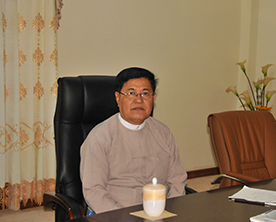
Part 2 and the concluding part of an exten- sive interview with His Excellency U Soe Thane, part 1 appeared in the May issue of Myanmar Insider.

[paypal]

MI: As one of the key reformist min- isters within the present government, what are the challenges faced by Pres- ident’s office when considering what policies that suit Myanmar’s future best?

We have to use our judgment and ex- perience to implement strategies that work quickly. The President’s office portfolio is mainly advisory. So not many challenges there per se, I don’t give advice on all mat- ters. I focus mainly on economic develop- ment concerns. Even though I am just the coordinating minister, I have to push the re- spective ministries to move forward quickly.

Our current mindset seems to be stuck at activity based. Programs were started, opening ceremonies were held, and that seemed to be the end. These were activities not results. It has got to change to result based. I want to know the outcome, not all these activities. Even the ministers have to be reminded very frequently to change to- wards results based leadership.

The main challenge that I am facing now is capacity constraint. If people have ca- pacity, they know what to do based on their experience and skill set. We experience capacity shortage in every layer of our administration.

Our constitution was based on that of Indonesia. Not India, not Thailand. Ours was essentially based upon a combination of Indonesia and US constitutions.

There are also significant capacity shortage among the general population and workers. Of course, we cannot just get dis- appointed and give up. We need to push and push to move forward.

I remember these words by US As- sistant Secretary of State, Kurt Campbell, during one of our meetings: “Democracy is not an easy system to accomplish; it would be a long journey. It is fragile and you have to be careful.” He continued “your main prob- lem will be managing expectations. When Myanmar people think of democracy, they straight away think of America and get their expectations up to US standards. It took us more than 100 years to reach that standard. The capacity of your government is well be- low fulfilling these expectations at present. This expectations gap is an issue and you need to narrow the gap.” All his words have rung true today. That is the main challenge I am facing now.

MI: What are the main policies your Excellency expects to be implemented in the near future to enhance Myan- mar competitiveness in the region?

AEC (ASEAN Economic Community) is coming in 2015. We need to prepare for that. The main path to prepare for would be to cooperate with foreign investors through joint ventures or other setups. That’s the only way to get the technical knowhow and the required financial investment capital. Only then, will our products improve on quality with an affordable price tag.

We are pushing the private sector to understand this and not push backwards by asking for protectionism. A number of large business organizations are asking for protec- tionism. Protectionism would not help pre- pare us for 2015, only cooperation, partner- ships and regional connectivity.

Local businesses can be assured that we are not going to be gung ho about letting in foreign investments and investors. Our aim has always been sustainable and all in- clusive growth, always targeting responsible investments that respect human rights.

MI: With the benefit of hindsight, would you have done anything differ- ently when you started your position with as the Chairman of MIC (Myan- mar Investment Commission), and why?

When the new government came into power, they couldn’t find an appropriately qualified person to head the MIC. Eventually the President asked me and I obliged to be the chairman for a year.

I managed to complete the new FDI (Foreign Direct Investment) law during my tenure.

Previously, the MIC was headed all by civil servants. During my term, I changed its composition to have equal participation: five from government, five civilian experts and one attorney general. The five from govern- ment are ministers. Each person carries just one vote.

After my tenure of slightly more than one year, I passed the chairmanship to Min- ister U Win Shien. People had thought that I would stay in MIC for a very long time, like previous chairmen. In the history of Myan- mar, the very first MIC with civilian partici- pation happened under my term.

MI: How do you feel about foreign companies now entering into business here will affect the local workforce, and do you feel that they will bring new opportunities to existing local businesses?

Previously, the only foreign compa- nies here were only from our north. Now that Myanmar has opened up, we have expanded our circle of friends to include Korea, Japan, Singapore and the West. With that expan- sion, we began to understand the concept of  responsible investment. Previously, we did not understand the concept.

The truth is until a couple of years ago, the concept of corporate social responsibility did not exist within the government. With the current batch of responsible investors, there will be better news for the workers and our country.

During my tenure at MIC, I drove hard to reach the minimum wage to US$3 per day. I understood that this depends on the nature of investment. Even now I am pushing hard to reach $3.5 to $4 per day for this year. It is possible, especially for foreign companies, whose market is larger than just the local market.

As long as we have foreign companies who follow rules and best systems, workers will learn to adapt to better systems. With the country opening up, workers will be ex- posed to better working conditions, better conditions of employment and getting better support from NGOs and global labor organi- zations.

MI: From a country development standpoint, what do you feel are the biggest challenges facing the current government in the next 1-3 years?

I believe we will move ahead in terms of economic development. Our geographical position already yields us significant poten- tial. We are also resource rich. We also have plenty of labor, putting us in a good demo- graphic position. We have made good prog- ress compared to two years ago.

I cannot forecast too much on politics. Politics is very fragile. If you look at us 70 years ago fighting for independence, every- one in the country regarded the fight for in- dependence as their first, second and third priorities. If everyone moves like that, not at- tacking one another, then the country would move forward very quickly. For the present, if we move with the objectives of peace, de- mocracy and people welfare as top priorities, then political stability would not be an issue. I cannot speak of the situation if people for- get these and focus on attacking individual credibility and characters.

MI: What sort of quality and respon- sible investors should our government target to attract? What are the key factors for consideration?

We cannot be too greedy and set too many restrictions. We have to look at our- selves and understand our own situation at present. Our existing condition is an agricul- tural based economy. We want to encourage investments into this sector, to create added value, rather than just selling raw materials. The second priority would be labour inten- sive industry to bring about mass employ- ment with low skills requirements and little energy consumption. These two would be granted easy approval and given assistance by government. In the case of e.g., mining, we will scrutinize thoroughly as it has significant impact on the environment.

We are also pushing hard for infrastructure development at present, to in- crease power and electricity supply, build roads and bridges and improve ICT facili- ties. Once these developments take off, we will start pushing for knowledge based in- dustry investments. Currently heavy indus- tries have to be put on hold as we have power shortages.

We are also taking in investments relating to electricity and power generation, but I am not sure how long they will continue, as the supply is dependent on our natural gas availability.

We will try to assist them as much as we can. We have an investment office set up in Yangon and we will reply to them within a week if we approve and we will complete the formal procedures within 90 days of their in- vestment application. We are also trying to make the investment office a separate stat- utory entity/board, just like Board of Invest- ment (BOI) in Thailand.

There is another initiative that our government is trying to do. Since Myanmar is rich in many natural resources, we have started discussions to join EITI, the Ex- tractive Industries Transparency Initiative. We are now ready to apply for candidacy. Once we are certified, we will publish the statistics on production, taxes we received

on production, etc., for the benefit of general public.

MI: For local enterprises, what sort of changes do you hope to see them adopting to be able to compete or co- operate wi

With regard to ICT, now everyone can own a mobile phone as the prices are becoming more affordable. Previously one mobile phone line cost about $2,000 and only the rich could afford mobile phones. Now work- ers and farmers own phones. This is an im- provement.

MI: Will Myanmar practice “protec- tionism” to favor local enterprises while they prepare themselves to com- pete with the influx of foreigners?

We are pursuing the policy of provid- ing a level playing ground. It comes from AEC requirement to make the whole of ASE- AN market a level playing ground for ASEAN nations.

MI: With the Government welcoming foreign investors, almost every inves- tor is facing the issue of skilled labor shortage. What is being done to ad- dress this?

For the current industries we are welcoming such as low cost manufacturers, the government is providing training for workers. Since these factories have low skills re- quirements, the staff can be quickly trained and go to work almost immediately.

For other slightly more advanced manufacturing, such as automobiles, we can still train people to work in these factories,th foreign investors?

We already provide mechanisms to ease joint ventures and partnerships. For local businesses, instead of viewing from a protectionist perspective, they should con- sider ways of joining forces to create win-win situations.

We are in an era of globalization. If we look at Singapore, Malaysia, Thailand, Vietnam, etc., they all grew very fast due to foreign investments and partnerships with foreign entities. In my view, investments will yield better returns through partnerships and cooperation. The higher the level of technology and knowhow, the more difficult it will be to do it alone.

Currently, we have quite substantial growth in the areas of tourism and air trans- portation. Previously, there was not even a single plane to come and land at Yangon Airport. Now it’s operating 24 hours a day. Previously, visitor numbers to Myanmar were well below a million per year. Now it’s 3 million.

With regard to ICT, now everyone can own a mobile phone as the prices are becom- ing more affordable. Previously one mobile phone line cost about $2,000 and only the rich could afford mobile phones. Now work- ers and farmers own phones. This is an im- provement.

MI: Will Myanmar practice “protec- tionism” to favor local enterprises while they prepare themselves to com- pete with the influx of foreigners?

We are pursuing the policy of provid- ing a level playing ground. It comes from AEC requirement to make the whole of ASE- AN market a level playing ground for ASEAN nations.

MI: With the Government welcoming foreign investors, almost every inves- tor is facing the issue of skilled labor shortage. What is being done to ad- dress this?

For the current industries we are wel- coming such as low cost manufacturers, the government is providing training for work- ers. Since these factories have low skills re- quirements, the staff can be quickly trained and go to work almost immediately.

For other slightly more advanced manufacturing, such as automobiles, we can still train people to work in these factories,as we still have capabilities in these sectors.

However, it is in the services sector that we are facing difficulties, such as bank- ing, financial services, legal, etc. The experts in these areas require years of training and they cannot be created en masse within a year or so. We have close to nil capacity e.g., in arbitration. So we ended up hiring consul- tants.

We are engaging consultants in sectors such as telecom, energy, power supply, cen- tral bank, finance ministry, census for immi- gration ministry, etc.

In addition, we are inviting all Myan- mar talents to come home. In America alone, there are about 380,000 people of Myanmar origin living there.

One of the factors causing the delay of talented people coming back is the PR (Per- manent Resident) Law. It has been submit- ted to congress but not finalized yet. Once the PR law is there, a Myanmar person does not have to give up the US passport that he/ she is holding to come back and contribute here. With this initiative, we will have re- solved a portion of the talent issue.

Companies such as Ooredoo and Tele- nor in Myanmar are also working with the limited talent here. Of course, due to this limitation, the staff tends to have much high- er wages. I am sure you guys are also earn- ing better working for Myanmar Insider, compared to others. This is part and parcel of democracy. In capitalist democracy, com- panies are free to pay more and choose the best staff with the highest caliber and capac- ity. What boss in the world wants to employ untalented staff! The staff in return has to try harder and go for both personal and profes- sional improvement. Of course, in the social- ist economy, the government will employ all people. In a democracy, it is not the govern- ment’s duty to employ people. We will create an environment that will enable people to find gainful employment.

MI: There any many well qualified Myanmar people who are presently residing overseas. What are the plans to attract them back to Myanmar?

As mentioned previously, we have already submitted the PR (Permanent Res- ident) law for enactment. Once the law is there, all will find it easier to come and work officially here. If you are educated, talented or have money to invest, you will stand a favorable chance of becoming a PR. We will give PR status for 3-5 years, where the PRs can travel freely in and out of the country.

MI: Regarding education, what is the immediate plans to restore the glory days of Myanmar education standard back in the early 50’s and improve the employability of Myanmar citizens?

We are currently undertaking educa- tion sector reforms. There are two specific parts to this. One is that of basic education and the other being higher education.

We are changing teaching techniques and methods for basic education. We now provide free education up to the middle school (8th standard). From next year on- wards, we will also provide free education up to the high school level (10th standard).

We are also decentralizing the con- trols, moving the decisions on teacher move- ments from centrally controlled to being controlled by respective states or divisions. We have been improving student teach- er ratios too. Previously in primary school, there were only two teachers per elementary school. Now we provide five.

For higher education, we intend to form a university council to manage all the universities including their tie ups with foreign higher educational institutions and managing their own budgets. The govern- ment will continue to provide some level of funding.

MI: Some investors are adopting a wait and see attitude; investors are looking for long term stability af- ter 2015. What are your Excellency’sthoughts o n the political stability of Myanmar post 2015?

I don’t blame the investors for adopt- ing a wait and see. After all, it is their mon- ey. Of course, if you are investing one or two million, the decision can be quite fast. If you are investing a billion, however, investors will take their time based on their own ex- periences. Personally, I am not in favor of waiting due to political reasons. I am sure you will realize that we need economic devel- opment here. With economic development, there will be a tendency to favor political stability.

Economic development is always re- lated to political stability. If we have low unemployment levels here and general in- crease in wages, there will surely be political stability. The poorer we are the more politi- cally unstable we will become. So my advice would be not to wait and see. Otherwise you will be late.

Politics is the same. Even after 2015, there will be the 2020 elections. If you wait

until such and such is in power, you will get no work done. The people who are keen to work will not wait for you. Nor will the coun- try which is poised for growth. The large markets of India and China will not wait for you. AEC will not wait either. If you come now, if you produce now, you will get profits faster. If you want to wait, you can. Others will come in and take up the opportunities. There are many people coming to see us to invest.

Even though people are saying 2015, it is the end of 2015 or rather the beginning of 2016 that the elections are needed to be held. There could be changes from now till then; in terms of stability, mindsets or other things. The situation can become better or worse.

It is not just this time. Democratic governments change one after another. Are we going to wait for 2020 too? As long as there are rules and regulations in place, we just have to invest according to these rules.

MI: How severely are the minority and ethnic issues impacting Myan- mar’s future development?

It has a lot of impact. That’s why we started the peace process. Now we have cease fire agreements with majority of the armed groups. It contributes significantly towards the country development. Everyone can travel freely without fear of being cap- tured or killed.

We normally follow the peace process with political dialogue. The results of the political dialogue are extremely useful for regional development.

Almost all the ethnic groups have asked for equality. I see this as equity. The solution is the development of the country. If the country becomes richer, we can all share the fruits. If the country is poor, everyone will remain poor, regardless of what ethnici- ty you belong to.

The next issue is power sharing. Once the peace agreement is in place, they will have more legitimacy in governing their own regions, as the government recognizes them as official representative of their people.

For resource sharing, it is also the same thing. With development, there would be more revenue sources for government to share. If you look at the national budget for the current fiscal year, you would notice we are distributing a lot more resources to the regions than previously.

MI: What advice would you give to someone looking to start up a busi- ness and invest in Myanmar?

I invite them to come to Myanmar. Our situation and potential is very good now. The talk is that who is going to be elected as President in the 2015 year end elections. Whoever wins is not important, what is im- portant is that who is elected must be able to contribute to the betterment of the nation. So if you are waiting for 2015, I think you are waiting for one thing that is not important, e.g., Coca Cola is here, GE? is here. We have agreements and contracts with them. Who- ever is going to take over after 2015 has to honor these legitimate contracts and agreements.

Carlsberg from Denmark, Telenor from Norway, and Ooredoo from Qatar they are all here already. The previous govern- ment has laid gas and oil pipelines with the Chinese. There is no way that we are going or able to remove these investments. These previous investments also brought revenues to government. The issue then becomes knowing how much money is received and making it transparent to the public.

For Myit Sone, it is slightly different due to environmental impacts and related environmental issues. For as long as you do the best for CSR?, etc., there is nothing to worry about. That’s why investors must come now. You will get into better positions the earlier you come.

MI: How do you see Myanmar comparing with its Asian neighbors in the short and long term future?

If the next two governments can con- tinue the path that we are currently follow- ing and they also are capable, we will become a rich country occupied by rich people, with- in ten to fifteen years.

If you are changing or renovating a house, you can do it within a day. If you are changing a country of 60 million population, we have moved very fast ever since we took power. No one is sleeping or lying down.

We cannot really move like a city state capital Singapore, where the population is only 5 million.

MI: If you could make one major change in government policy rightnow, what would it be?

I do not foresee any major change right now. Our current four pillars of reforms are quite comprehensive. The main issue is to implement them successfully.

MI: What is the message that you would like the world to hear from the present government?

We are trying to become a democrat- ic country and at the same time, become a responsible member of the global commu- nity. The world also recognizes our efforts. Unlike previously, Myanmar people receive better treatment overseas. More people are willing to shake our hands. This is something we could be really proud of, on behalf of our country.

Previously when foreigners heard of Myanmar, they turned away from us. Now they run to us to greet us. We are finally get- ting back to where we belong.

We are not resting on our laurels. There are still so many things to do and we are still pushing hard. That’s why all the world organizations and countries give us recognition.

If you look back over the past two and half years of current administration, you would be hard pressed to find a world leader who has not visited Myanmar during this period.

Since we gained independence, we have nev- er had such interest in us until now. We are now a much welcomed participant on the world stage.


[/paypal]

The Australian Ambassador Interviewed

Name: Bronte Moules

Country: Australia
Job Title: Ambassador

Profession: Career Diplomat

[paypal]

MI: What is the mission of Australian Embassy here?
The main mission here is to develop bilateral relations between Australia and Myanmar through promotion of political, economic and trade ties – through government-to-gov- ernment as well as direct people-to-people links. We also deal with immigration issues, visa processing and we co-operate on com- batting transnational crime, especially in re- lation to people trafficking and narcotics trafficking. We also provide consular ser- vices for Australians travelling to Myanmar.

MI: How do you describe the history of relationship between Australia and Myanmar?

We have a long and interesting history. The Australian Government started its official presence in Yangon in 1952, and we have had a continuous presence in Myanmar from then till now. Of course, our bilateral rela- tions have gone through different phases during this long period.

Education linkages between our two coun- tries date back a long way, including through the Colombo Plan. We have also been in- volved in many development projects here over the years.

MI: Tell us one thing that surprised you when you first started your assign- ment in Myanmar.
I started my assignment here in January 2011. When I first arrived, most people I spoke to did not think the country would change much from the status quo. But things really did start to change that year, much to everyone’s surprise. We then saw many

things start to evolve, one after another, across a range of areas – political, economic and social. This in turn changed the work of the embassy here, by opening up new areas of engagement.

MI: What are the focus sectors/indus- tries that would suit an Australian company to invest in Myanmar?
The sectors where we see the most potential for Australian companies in Myanmar are mineral resources, infrastructure (particu- larly power and water), agriculture, and fi- nancial and professional services. We also think there is significant potential for Aus- tralian education institutions to deliver courses in Myanmar when the time is right.

MI: How many Australian companies have invested in Myanmar so far?
The figures are still quite low. But a large number of Australian businesses are coming

here, visiting and exploring opportunities. The Australian Trade Commission – Aus- trade – re-opened an office here in Yangon in middle of last year (it had not had an office here since 2000). We anticipate the number of Australian companies investing in Myan- mar will increase as the country’s economy, especially its resource sector, develops.

MI: Mining – Australia as one of the world’s largest mining countries, and Myanmar has plenty of natural re- sources. How do you see the develop- ment of the mining industry in Myan- mar?

Just like in Australia, we want to see the mining industry develop in a sustainable and transparent way. This in an industry which could be a major contributor to economic growth and improved living standards in Myanmar. Australia has a lot of experience and world class technology in the mining and oil and gas sectors, and in related industries such as specialist equipment, engineering services and environmental management. Ausralian expertise in supporting industries extends also to financial services.

MI: Agriculture – Australia is well known for its dairy product and cow farming. Myanmar has plenty of land but lacks dairy product availability; how do you see Australian companies playing a part in these areas?

Australia is a major agricultural nation, with a long history in dairy and beef production, as well as horticulture, grains and pulses pro- duction, and production of textile fibres such as cotton and wool. Some parts of Myanmar have a similar climate to that of Australia. So there is much we could offer in the way of re- search and development to improve the effi- ciency and productivity of Myanmar’s agri- culture sector through, for example, new seed varieties, farm management, improved crop storage and transport systems.

MI: How about technical knowhow and soft skill training in the relevant areas?
There is good potential for co-operation in this area. Because of our experience in these areas, Australia has developed extensive technical know-how in key industry sectors such a mining, oil and gas exploration and production, agriculture, infrastructure devel- opment and environmental management. We have developed comprehensive training and skills development programs in these ar- eas. Many vocational providers in Australia are showing interest, to assist Myanmar in creating linkages between vocational train- ing, industry and policy development.

MI: Are you satisfied with the current reform process? Which areas have exceeded your expectations and which areas have not?

We recognize that very serious efforts have been put in to the current reform process, and are still underway to continue to reform and open up the country and the economy. Australia has been very encouraging and supportive of the efforts of the Myanmar gov- ernment, and of the country in general, to reform.

With regard to expectations, they need to be realistic. It is vitally important that the re- forms bring benefits to the people of the country, but it’s important that the public and the media be realistic about how quickly this can happen. It is clear a lot more reform is needed, and that this will be a long-term process because the reform agenda is mas- sive. It will be important to keep pushing for and working for more positive change.

MI: Australia focuses a lot on environ- mental related matters. What is the priority of Australian government to assist the growth of this country and at the same time provide the support on environmental related issues?

We have been supportive of political and economic development being done in a way that is socially and environmentally sustain- able and that contributes to rising living standards. We want to see Myanmar gain prosperity without damaging its environ- ment. We have supported Myanmar’s appli- cation to join EITI (Extractive Industry Transparency Initiative) through study tours and technical support.

MI: What are the main policies your Excellency expects to see in the near future to enhance Myanmar’s compet- itiveness in the region?

We would like to see changes to the mining law to promote transparency, predictability and sustainable development. Introduction of foreign banking services, to provide essen- tial financial services that support FDI into Myanmar, would also be needed. We’d also like to see: policies that provide greater cer- tainty around land ownership and tenure; reform of Myanmar’s education and training sectors; and policies that tackle obstacles to efficient business development such as infra- structure bottlenecks, corruption and access to critical information, in order increase the long-term competitiveness of the country.

MI: How do you feel that foreign com- panies now entering into business here will affect the local workforce, and do you feel that they will bring new opportunities to existing local businesses?

The entry of foreign companies into an emerging economy can bring a lot of benefits to the country and its workforce, if it’s done properly. It can mean more job opportuni- ties for skilled and unskilled workers, better access to new technologies, higher wages and training and skills development. In ad- dition, foreign companies can bring a com- mitment to CSR (corporate social responsi- bility) programs to support local communities.

For local businesses, there are a few consid- erations: the government needs to promote

the build-up of local businesses as support- ing industries for FDI, and capacity building among local SMEs. The partnerships created can deliver win-win situations, with more benefits through adopting a collaborative ap- proach.

MI: From a country development standpoint, what do you see are the biggest challenges facing the current government in the next 1-3 years? From an economic perspective, a key chal- lenge is to manage the speed and scale of economic development. It’s very challeng- ing, but important, to put all the pieces in the right place in the right order at the right time, including in relation to infrastructure, education, access to land, access to banking and financial services, and the legal and reg- ulatory framework, to name a few.

Another key challenge is the peace process, the success of which is needed to create a sta- ble and more certain platform for economic and social development.

The government will also need to manage expectations about the benefits that will flow to people from the reform process, and to en- sure that these benefits reach all members of society.

MI: Some investors are adopting a wait and see attitude; investors are looking for long term stability after 2015. What are your Excellency’s thoughts on political stability of Myan- mar after 2015?

We are working to try to support positive change in Myanmar, and we believe contin- ued support for the reform process is very important. We will continue to help build up national institutions and capacity and pro- vide technical advice to develop industry. Much of our assistance is directed at helping people and building up capacity, particularly in the education and health sectors – this is of vital importance irrespective of political developments. In other words, our develop- ment assistance is intended to be useful re- gardless of what happens politically.

MI: How do you see Myanmar com- paring with its Asian neighbors in the short and long term future?
I am optimistic that Myanmar can have a bright future because of the reform effort. Myanmar has many attributes needed for economic prosperity. If development is done well and in a sustainable way, there is no rea- son why Myanmar cannot reach and exceed the same level of economic development as its neighbours and enjoy similar living stan- dards, including access to education and healthcare.

MI: What would be your advice to an Australian company before putting their money into Myanmar?
Our advice to Australian companies that are considering investment in Myanmar is to be patient and persistent. It’s important to spend time here, to research thoroughly, to understand the Myanmar market and its op- portunities and get to know the local busi- ness scene, and to invest for the long term in a sustainable and socially responsible way.

[/paypal]

Fifteen ways of looking at Myanmar’s political and business culture

  1. The risk associated with the 2015 elections is not as high as it is made out to be by the media and commentators. Daw Aung San Suu Kyi has shown that she is willing to compromise. The military knows that they cannot move back to the regime they had in the past. Cronies don’t want to rock the boat and in fact want to benefit from the growing economic pie and opportunities. Ethnic rebels are tired of fighting, and now that there is the prospect of greater autonomy and economic benefits accruing to themselves and to their states, they too want peace and stability. There is virtu- ally no significant segment of society that will benefit from reversing the political course.
  2. In the late 1980s, a leading opposition member suggested that Nuremberg type trials would take place once the military regime was changed. This one statement had disastrous consequences, and blocked any move by the military to soften its stand for the following 20 years. That hunger for retribution has retreated. The willingness of the people in general to look forward rather than backwards is hugely positive.
  3. The world’s eyes are trained (disproportionately) on Aung San Suu Kyi. Her party, the NLD, will likely win, but she is unlikely to be President in the first part of the term until the Constitution is changed. In that scenario, she will find a proxy and will effectively be the de facto “President”. Unfortunately, this may usher in more problems that one would like to believe. There is hardly anyone with administra-tive capability within her party, and most of the leaders are in their 70s. Moving towards democracy is one thing, sustaining it by maintaining the momentum of economic growth is something else.
  4. Aside from Aung San Suu Kyi, potential investors should track the ascendency of Thura Shwe Mann and Senior General Min Aung Hlaing. The latter is the Com- mander-in-Chief of the Myanmar Defence Forces and because the military is the only effective institution in the country (whether one likes it or not, this is a fact), he will likely play a major role in Myanmar politics.
  5. One cannot underestimate the depth and intensity of issues related to ethnicity, religion and nationality in the country. There are historical reasons for the mistrust of Muslims, the Chinese, and the Indians. The sectarian conflict will continue indef- initely, and because of the combustible nature of such sentiments, there is always the possibility that an event could trigger an explosive sequel and global reaction.
  6. The British colonial period led to the deep segmentation of ethnic groups and peo- ple within the country. It is not too much of an exaggeration to suggest that there exists elements of a “bumiputra policy” (the phrase comes from Malaysia) in favor of the Bamar Buddhists, who make up the majority of the population.
  7. The real risk in the country is not so much the 2015 elections or politics, but on the economic front. There is cause for concern if one looks more deeply into theYangon street market exchange rate competitiveness, the trend of central bank reserves, the emergence of what is known as the “Dutch Disease” effects arising from oil/gas exports, NGO money flooding in, and the telecom/mining sectors soaking up scarce resources from the rest of the economy. There is a serious lack of appreciation of the eco- nomic risk within Myanmar, and the ability of the policy makers to address them effectively.
  8. There are so many opportunities that businesses and individuals get tempted by the large number of projects, and it is very difficult to secure any loans. Hence, one of the most precarious situations in the economy is the very tight cash flow of many businesses. At the same time, these businesses have really not seen or experienced how destructive market forces can be – there has been a virtually “flat” cycle in Myanmar for the last 30 years. If and when there is an event- shock, whether it originates locally or globally, many businesses will be under serious risk of going bankrupt.
  9. As everyone knows, seeking the right partner is at the heart of doing business in any frontier country. On the subject of who is credible and who is not, the views from inside the country – i.e. of the locals and veteran foreign business people — can be very different from the view of those outside the country. Those investors who come from the outside will relate better to someone who can talk their talk, and who market in the way they can relate to. Those people inside Myanmar have a view that is influenced by how they see certain businessmen behave when times were tough. There were some local businessmen who refused to pay their debts and behaved unethically during the tough times, and only the people inside the country know who they are.
  10. Do not take the Foreign Investment Law (FIL) as a concrete immovable document It is actually a “work in progress”, and most aspects of foreign investment, includ- ing foreign shareholding is negotiable. It all depends on how much any investor brings to the table and how much benefit will accrue to the local economy and work- ers.
  11. On lobbying, while we see that there are strong protectionist tendencies, the im- pact is very different from the situation, say in Vietnam. In the latter, there is one overwhelming source of power and control. The power and lobbying structure in Myanmar at present is not as concentrated, and the dynamics at play are more fluid; there is always the scope to influence decision making much more than say, in Vietnam.
  12. One of the most under-rated aspects of operating in Myanmar is superstition. It would be hard to find any other place where for example, the location of the new capital city and how the currency was denominated (it used to be that the currency was denominated in 9, 90, 900) is based on superstition. Even locals who have exposure to the outside world will sometimes not partner or hire a skilled manager if he is born on the wrong day of the week (that clashes with his own day of birth).
  13. As the country has been in a time warp for nearly fifty years, local businesses suffer from a serious lack of exposure as to how the outside world thinks and behaves. The difficulty of dealing with local stakeholders should not be underestimated. You will also see this gap in understanding when dealing with the staff at lower levels. The working population has to return to the work ethic that comes with the new environment. In the past, whether one worked hard or not, there was very little opportunity to move ahead and get a meaningfully better life. The situation is to- tally different now. With this, the work ethic and energy that the local work force possesses will change, but it will take time.
  14. Perhaps more than in other places, the posture of Myanmar businesses has been molded by its past to be extremely short-term in perspective – they always needed to secure the payback and get back their returns as soon as possible, and then stash the money in some way (gold, land and previously cars), because they never knew what might happen next. After all, there had been several rounds of demonetization in the economy. This short-term attitude and a broker mentality is deeply embed- ded.
  15. By far the most challenging aspect in Myanmar is “execution”. There are opportu- nities everywhere but the effort to start up the business and to operate it efficiently and flexibly is the real challenge. There are a host of administrative hurdles, lack of human resources, an evolving and fluid regulatory environment and so forth. As such, a step by step approach to learn how things are done on the ground, initiate with organic growth and to track regulatory shifts are perhaps the most sensible ways to enter the market.

Latest Videos

Interview with Alison Fox Principal of The British School Yangon

Interview with Alison Fox Principal of The British School Yangon

Recent Posts