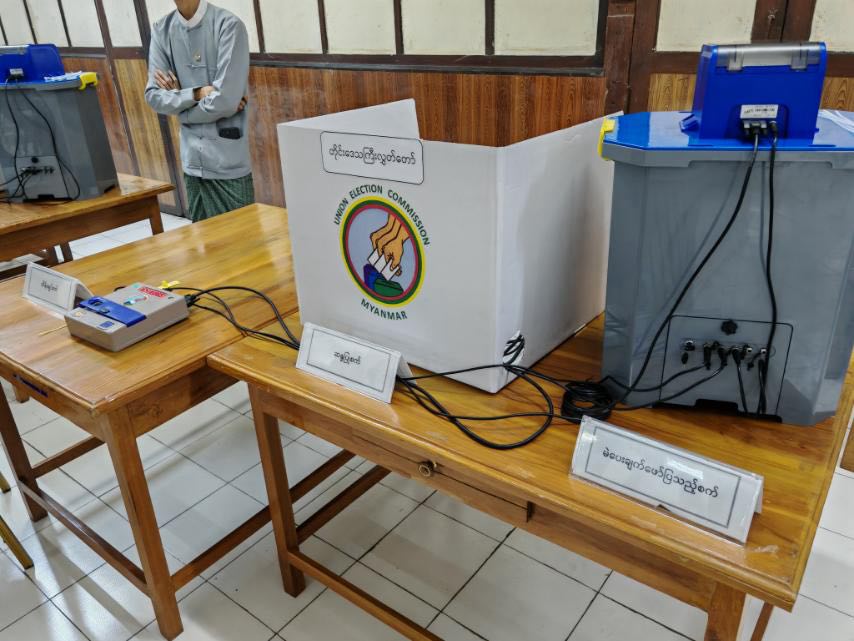
After the elections fraud under Su Kyi administration in 2020, the government is coming up with a solution to mitigate the chances of fraud, at least in the counting of the votes and to eliminate any chances of void votes. We may still be unsure if we are using first pass the post system or proportional representation in the election process for the upcoming elections, but at least the machines are ready. Rumours have it that for the lower house, we be using the former for the lower house and the latter system for the upper house and regional parliament. UEC (Union Election Commission) together with the Media Council (MPC) introduced these machines to local and foreign media on July 4.
Voters might still be having reasonable concerns over their personal safety and security from NNCP terrorists. UEC so far has not addressed this issue yet. But the commission is quite optimistic in its security assessment that it expects more than 260 townships out of the total of 330+ townships to be in a position to conduct free and fair elections. The terrorists will definitely be targeting potential candidates. But candidates themselves are also taking precautions. The leader of PPP party, Thet Thet Khaing, has told to MI that she would be campaigning online only and avoid field campaigns and meet the people sessions at all costs. In the absence of potential parliamentarians to target, the gunmen would undoubtedly create an environment of fear and anxiety through violence so that the voters end up staying away from the polling stations.
Named MEVM, acronym for Myanmar Electronic Voting Machines, they were developed by Ministry of Science and Ministry, one small ministry that we did not hear much about doing anything significant. The ministry is in charge of all technology related universities within the country, after putting them in and out of Ministry of Education. They are also in charge of materials testing centres, albeit the most of these testing machines neither new nor in working order. Innovation and research departments are also under the ministry even if the news of their innovative research and development do not reach public much. More than 50,000 MEVMs will be produced and distributed for use. All the machines are expected to be in use in the upcoming general elections towards the end of the year.
Booths and Macs
A typical voting centre will have three voting booths; one to vote for a lower house candidate, another for the upper house candidate and the last one to vote for the state or regional parliamentarian. As seen in the pictures, the booths are well protected. You vote can still remain a secret. You enter from one side and exit from another, making the arrangement more organised. Inside the voting booth there is a controller with large buttons. Next to each button is the name of the political party and/or the candidate (representing the party). The candidates and buttons are positioned into rows. The voters simply have to press the button corresponding to the candidate that he wants to vote for.
The machine will also print a slip of your vote as evidence of voting, from the smaller printer attached.
“The MEVM makes voting easy and simple. It does not require internet or electricity, and it is lightweight and portable, allowing it to be used anywhere. The machine uses a UPS battery, commonly used in computers, which can be easily purchased on the market. Provisions have also been made to accommodate voters with disabilities. The machine has been tested hundreds of thousands of times for flaws, and none have been found so far,” said Nyi Nyi Lwin, Deputy Director-General of the Union Election Commission, at the July 4 event.
He further explained, “At the voting booth, the voter must select their preferred option when the green light above the voting machine button turns on, and then press the button to cast their vote. The voter can also review the ballot paper on the monitor to confirm whether it reflects their choice. The MEVM will generate the voter list shortly after the polling stations close, eliminating the need to wait for hours. This MEVM can be easily used not only in the general election, but also in referendums and other elections for Union-level organisations.”
By using the MEVM, issues such as rejected votes and problems associated with paper ballots, like wax markings or the insertion of duplicate ballots, will reportedly be eliminated.
Power to the People
With so many electricity issue even in the capital, you would be forgiven for wondering how these so called electronic machines are going to function with intermittent power supply. Fret not, the machines are run using the battery power only. Two batteries are provided; one for running and the other one as back up. MI did ask the question on what if both batteries got stolen the day prior to the voting day. The response from UEC was that it is the same battery used in motor bikes, so you only have to put in one from your motor bike. Not bad for the time being.
Another issue is the printing. Once you have voted, the screen on the left side of the voting booth will show your decision and ask whether you want it printed. It might be a good option, but the printed vote could expose you to the terrorism gang waiting at some corner of the street to interview you on how you have contributed to the success of the election. With printed evidence in hand, you be hard pressed to lie right at their faces to avoid joining the stats on victims of terror.