Home Blog Page 3

Myanmar Women’s Team Brings Home ASEAN Silver

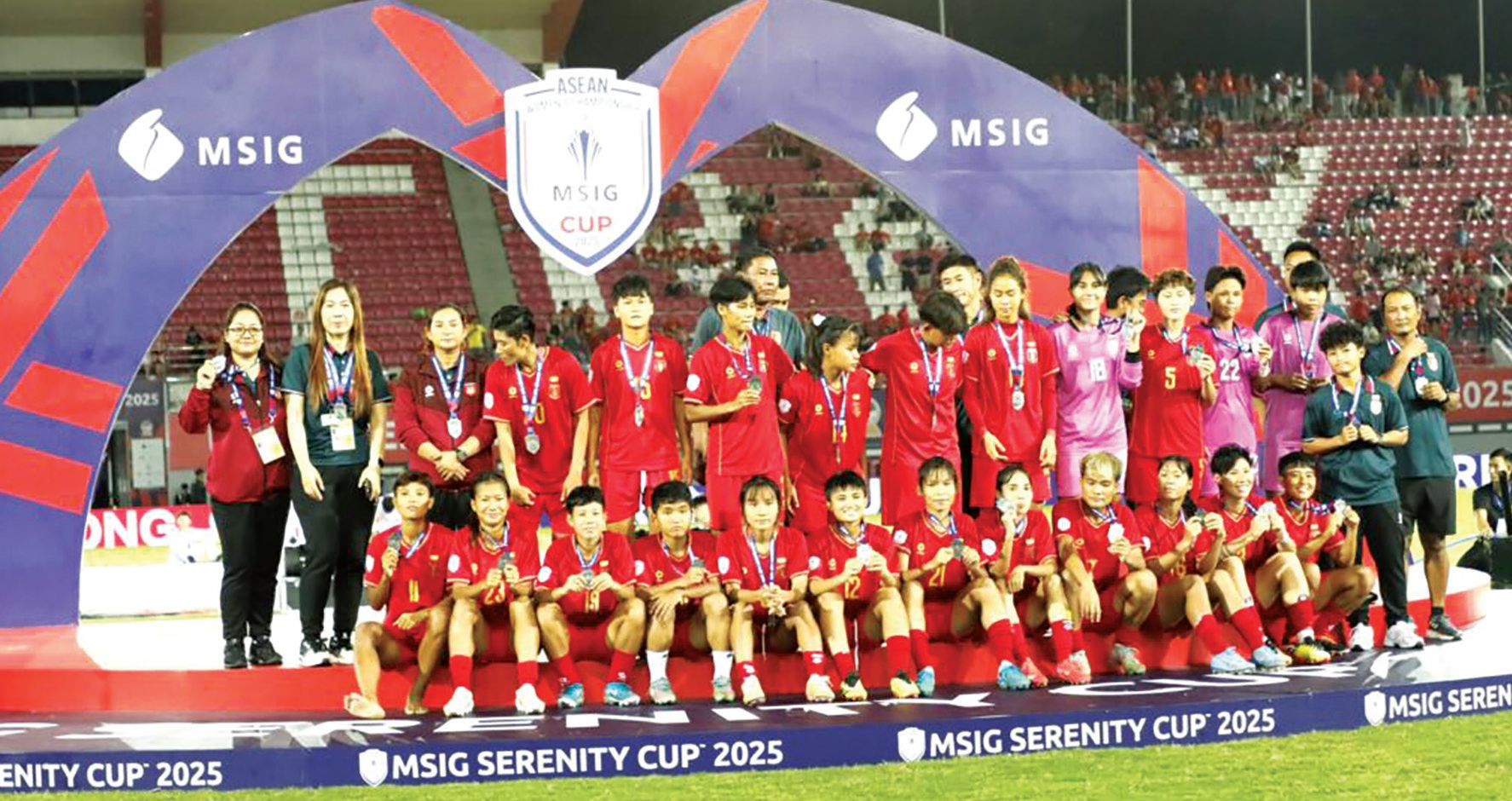
Myanmar national women’s football team, which won the silver medal at the ASEAN Women’s Championship 2025 held in Vietnam, was warmly welcomed back at Yangon International Airport on the evening of August 20. The team, led by Head Coach Yuki Tetsuro and Manager U Kyi Lwin, competed with a total of 23 players in the championship and secured the silver medal before returning to Yangon.
Yangon Region Chief Minister Soe Thein, regional ministers, Asian Football Confederation Senior Vice President and Myanmar Football Federation President Zaw Zaw
and other officials, athletes from the Myanmar Football Federation, trainees from the Institute of Sports and Physical Education (Yangon), parents, people, and responsible personnel welcomed back and honoured the team at the airport.
In the final match of the ASEAN Women’s Championship 2025 held in Vietnam, Myanmar played against the Australia U23 team and lost 0-1. At the awarding ceremony, the Myanmar team received the silver medal, while Win Theingi Tun of Myanmar won the Top Scorer Award and Myo Mya Mya Nyein of Myanmar was named the Best Goalkeeper.

Diary of a Candidate

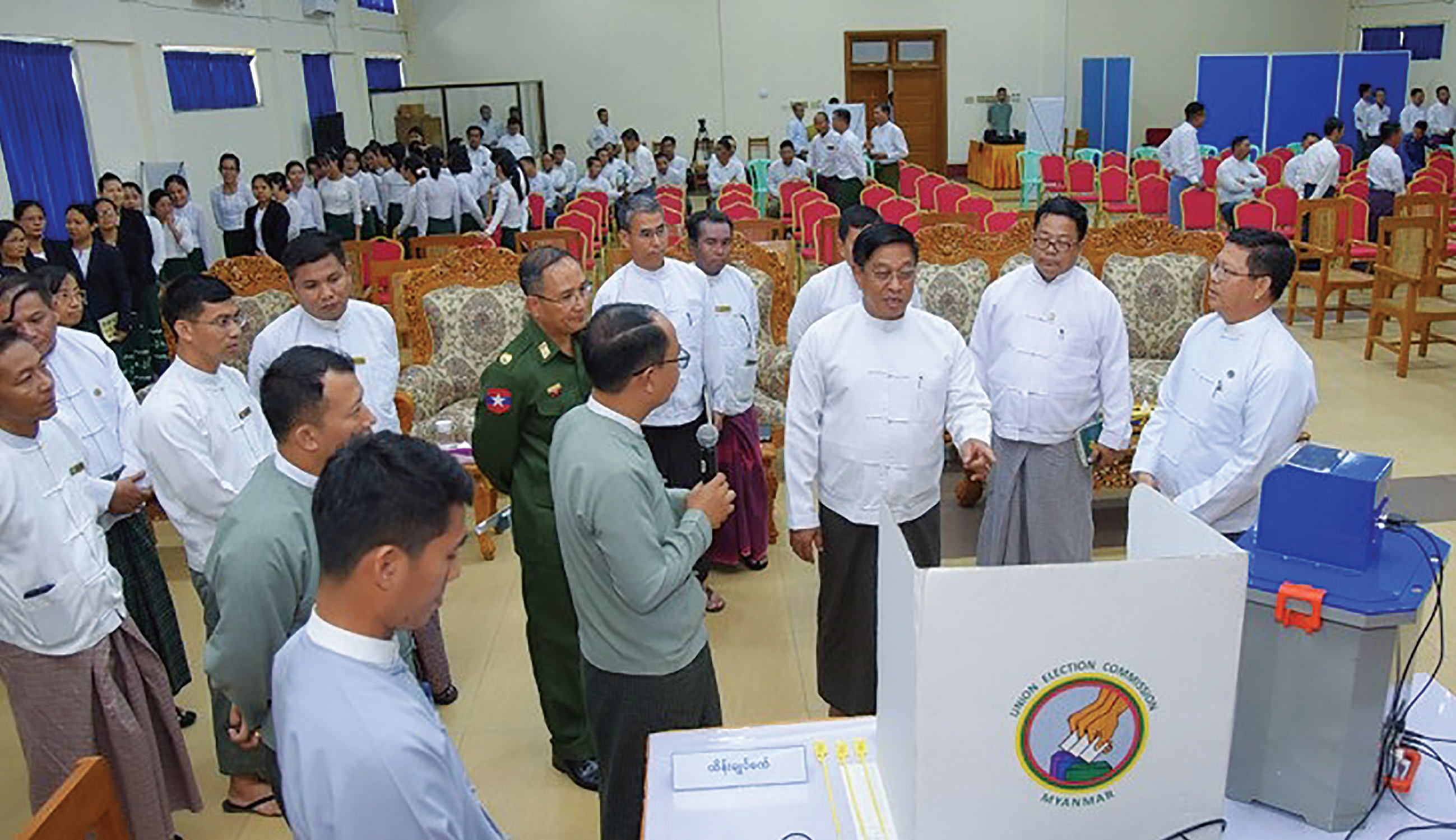
Elections season is coming and the temperature is going up to feverish category as we get closer towards the year end. MI managed to track down a candidate who wants to make a difference to the country and the state of affairs. Just let’s call him, Mg Ko Oo (MKO) for the time being.
MKO family was from the military background. As such, he felt that it would be a betrayal to Tatmadaw if he were to join any other party apart from USDP. Some political analyst and 88 generation (forever) student such as Yan Kyaw, clearly said it would be stupid not to contest as an independent this time round, but we will only know how accurate his assessment is at the end of January 2025. Even though PPP Chief has invited him to join her party, he had to politely deny as the existing party members would not think so kindly of someone who is willing to betray his roots. Just think of what happened to Shwe Man and how Su Kyi treated him after she got what she wanted. The other parties such as PP led by Ko Ko Gyi does not impress him either. The leader apparently does not fall under the category of being smart and intelligent. After he joined the USDP, he heard the ‘good’ news that the other three out of eight parties competing nationwide has been dissolved, due to their inability to meet some of the eligibility criteria; the main ones being inability to meet the minimum number of party members and the party branches across the country. Especially when the main opposition fo USDP is NDF where the remnants of the now-defunct party NLD ended up joining, the main rivals of the largest party USDP would likely turn out to be independents, who have no chance of a government formation by themselves.
The remaining six nation-wide parties
are:
1. USDP (Union Solidarity and
Development Party)
2. Ta Sa Nya (Nationalities Unity
Party)
3. People’s Pioneer Party (PPP)
4. Myanmar Farmers’ Development
Party (MFDP)
5. Shan and Nationalities Democratic
Party (SNDP)
6. People’s Party (PP)
The Road Rush
The deadline for the submission of the candidacy was originally on the 17th. The document requirements were not cumbersome yet not that easy either. Together with candidacy form, form for personal particulars, candidates are required to submit, educational qualifications, tax clearance, household list evidencing their stay in respective constituencies, bank deposit of 5 Lakhs (~$120), swearing in, in front of a judge, appointment of a representative and confirmation by the state, region or township UEC (Union Elections Commission) branch.
Our man, being the speedy Gonzales, completed all the documentations above by Friday the 12th, well ahead of the closing date. He has even started visiting a couple of USDP beaches in his designated district, touch base, network and discussed some plans for the campaign the following day. Being an election virgin, he has not expected the bombshell of USDP calling him on 13th and informing him that his constituency and representation has been changed. Previously he was contesting in a district within Yangon for an upper house seat and now he has to join the race in a township for a lower house position.
So it’s a redo all over, but he all put it as part of the elections experience. The good thing is the government instructed all respective offices to remain open on Saturday (13th)
and Sunday (14th), thus making the rush a lot more doable. Together with USDP candidates nationwide, MKO would submit the documents on Monday the 15th. The latest announcement from UEC has further postponed the submission date from September 17 to September 22, giving the impression that especially the bigger parties are not done with their allocation of seats. So far, as of September 15, nearly 70 candidates from various parties other than USDP has submitted their applications to the UEC.
During this period, USDP leader of Yangon region gave a briefing to all participants from Yangon region (comprising of upper house, lower house and regional parliamentary candidates). He highlighted the need to play fair and keep records of elections spending properly. Participants also took turns to introduce each other during the briefing. Currently the rumour, quoting one online political cele, is such that the applicants outnumber the positions only in USDP. The rest of the parties are having difficulties in getting enough candidates to stand in the available constituencies.
For MKO, this decision to participate in the general elections may be just a small step towards his interest in governance and government perhaps, but a giant step towards getting ‘Smarter people to create an even smarter government’!

Long Slow Death of Norway’s Wild Salmon

Wild salmon in Norway is facing a dramatic decline due to climate change and fish farming practices. Fly fishing enthusiast Christer Kristoffersen recalls a time in the 1980s when rivers were teeming with fish, contrasting sharply with the current situation where only 323,000 wild salmon returned to spawn in 2024, down from one million annually in the 1980s.
 This decline has led to the species being placed on Norway’s red list of near-endangered species. The Norwegian government has responded by suspending fishing in 33 waterways and implementing new restrictions, impacting tourism and the livelihoods of 60,000 to 80,000 sport anglers.
Fish farming, a $12 billion industry, has contributed to the decline through issues like sea lice, which harm wild salmon, and genetic mixing from escaped farmed fish. Calls
for reform in the fish farming industry are growing, with demands for sealed enclosures to prevent environmental impact. While the industry acknowledges the need for change, it cites challenges in transitioning to safer practices.
It is worth noting that approximately 70% of the salmons that we consume worldwide is farmed. This means that the vast majority of salmon available in the market comes from aquaculture rather than being caught in the wild. Especially in a developing country such as Myanmar, this percentage is likely to be close to 100%. And we may have no idea on how much mercury and antibiotics go into these farm salmons and the health and safety practices of these commercial salmon farms.

BRICS moves to Expand Global South Cooperation

Leaders of BRICS countries, gathering for the 17th BRICS Summit, reiterated their commitments to reforming and improving global governance by expanding Global South
cooperation. The meeting adopted the Rio de Janeiro Declaration, which calls for strengthening multilateralism and reforming global governance, promoting peace, security
and international stability, as well as deepening international economic, trade and financial cooperation.
Addressing the summit’s plenarysession themed “Peace and Security and Reform of Global Governance”, Chinese Premier Li Qiang called on BRICS countries to strive to become pioneers in advancing the reform of global governance, safeguard world peace and tranquillity, and boost the peaceful settlement of disputes. In 2015, Chinese President Xi Jinping put forward the global governance vision of extensive consultation and joint contribution for shared benefit, offering China’s solution to the global governance challenge. Ten years on, the vision has gained growing global influence as transformations unseen in a century are accelerating in the world.
“The world has entered a new phase of major turbulent changes, and the international order is undergoing a significant reorganisation. Following its expansion, the BRICS mechanism will unite efforts to promote common development, defend multilateralismand contribute more to building a more equitable global governance system,” said Boris Guseletov, a senior researcher at the Institute of European Studies of the Russian Academy of Sciences.

Laos Pushes Forward In Building Self Reliant Economy

Laos’ Ministry of Finance is actively  working towards building an independent and self-reliant economy, with a strong focus on optimising revenue, controlling expenditure,
and improving financial management.
The ministry has outlined several initiatives to strengthen the economy, including developing legislation, improving state budget management, enhancing oversight of state owned enterprises, resolving public debt, and modernising financial systems. The ministry plans to expand tax sources, including construction, environmental, and carbon credit, while modernizing revenue collection to reduce leakage. It also prioritises repaying both domestic and foreign debts, increasing national reserves, and investing in key sectors such as education, healthcare, and infrastructure. There will be a strong focus on reducing reliance on foreign loans and ensuring efficient use of public funds. Additionally, efforts to improve the management of stateowned enterprises, resolve public debt, and digitize financial systems will allow for more accurate tracking of state revenues and expenditures. These goals are set to be achieved by 2026, with some initiatives continuing into 2030.

Travellers Throng Bagan for Sunset Views

Local and foreign travellers are back in Bagan, possibly to enjoy the sunset views atop ancient pagodas. “Being a concentration site of cultural heritage of Myanmar, the domestic and foreign visitors visit Bagan in every season. The foreigners especially show their strong interest in Myanmar’s culture and natural beauty. The visitors watch the sunset from Nyaung Laphak Lake and Sulamani viewpoints. Most of the local travellers watch from the Buu Pagoda this season. The beauty of Bagan always leaves a strong impression on both local and foreign travellers, no matter the season or time. That’s why people who have visited before often come back again, and it is a unique sign of Bagan,” said an official of the Directorate of Hotels and Tourism (Bagan).
The visitors can enjoy the sunset and the beauty of the Ayeyawady river, Tant Kyi Taung (Taung = mountain in Burmese) and Tu Yin Taung from four viewpoints, two mounds, Nan Myint Tower and from other pagodas. The maintenance works are being conducted to ensure the sustainability of Bagan pagodas, and the authorities banned visitors from climbing the pagoda after the 2016 earthquake.
Neither the heavy rains during the raining season nor recent PDF attacks and kidnapping in villages and wards within Nyaung Oo township has dampened the mood of the visitors to visit #1 tourist spot of Myanmar.

CHID Bank Becomes Myanmar’s First ISO 9001 Certified Bank

Despite lack of transparency over the announcement, allocation and balloting of low cost housing units, CHID Bank has become the first bank in Myanmar to be certified to
ISO 9001, according to the bank.
With objectives to offer the most reliable banking services at international level, to create a better life and to fulfil the dreams of the youth, the Construction, Housing and Infrastructure Development Bank (CHID Bank) is a public-benefitting institution that won ISO 9001:2015 in July 2025, as it complies with the standards set by the international Quality Management System (QMS), according to a statement issued by the company.

14 Rice Mills to Use 18.4 MW Solar Power This FY

14 rice mills will install 18.4 megawatt solar power in the current financial year 2025/26 under the Public-Private Partnership, according to the Myanmar Rice Federation.
Shwe Wah Yaung rice mills inaugurated a ceremony to generate electricity with solar in Shwe Lin Bun Industrial Park in Hline Thar Yar Township. Shwe Wah Yaung Rice Mill has been equipped with 500 kilowatt solar power.
Of 28 rice mills that are designated to install solar as a cleaner alternative in grain processing, Sein Lae Myay rice mill is the first one equipped with (487 kW) Solar power, and the remaining are underway to install them, the Myanmar Rice Federation stated. Sein Lae Myay rice mills held a solar power event on July 22 in Nyaung Don Township, Ayeyawady Region, which is a solar power system in rice mills project under the guidance of MRF.
MRF and 17 solar companies signed a memorandum of understanding (MoU) to utilize solar power in rice mills designated for exports, contributing to sustainable rice processing using renewable energy. A preliminary assessment on the installation of 41.9-megawatt solar power projects at 28 rice mills by 17 solar companies began in March 2025, and installation is being undertaken. Furthermore, MRF has been planning a project for the paddy farmers to get access to solar-powered irrigation systems with an investment from private solar companies.

Yangon – Mandalay Expressway to be Upgraded to Four-Lane Road

Upon recent inspection along the expressway, Senior General has given guidance to officials to formulate the plans for upgrading the Yangon-Mandalay expressway to a four-lane asphalt concrete road.

SG also highlighted the need to restrict illegal restaurants along the expressway and limit the squatters and infringements into the designated highway zone.

Mobile Wallets Linked to MMQR rise to 11

Mobile wallets connected with MMQR have now expanded to 11, said MyanmarPay MMQR. Payments are also available with Yoma Bank, which is now connected with MyanmarPay MMQR, it announced on July 21.
“Now, there are 11 mobile wallets provided by MMQR, which enables business owners and merchants to accept payments through a wider payment landscape as well as customers to make more efficient payments than before,” said MyanmarPay MMQR.
Payment is available by AyaPay, KBZPay, WavePay, OK$, A+, uabpay, CBPay, ZegoMoney, Trustpay, CTZ Pay and Yoma Bank at every store connected with MMQR. Customers can make payment by their mobile wallet by scanning MMQR. MyanmarPay MMQR doesn’t need to be downloaded and doesn’t need to open a new account; just scan the QR through your current supported mobile wallets.
After spending nearly 10 years in development (MMQR started in 2017) the implementation is finally done, to the belated delight of many who wants to digitalise the financial sector like countries around the region.

Latest Videos

Interview with Alison Fox Principal of The British School Yangon

Interview with Alison Fox Principal of The British School Yangon

Recent Posts